
Risk management
Risk management
Risk management
We manage risks to achieve our long-term goals, protect the interests of our stakeholders, and safeguard our company's future. By identifying and managing risks at an early stage, we remain financial healthy, organisationally flexible, and trusted in society.
Organisation
Our risk management provides insight into strategic, financial, operational, and integrity risks. The aim is clear: to base our management on and anticipate changing situations and back up responsible choices with reliable information.
DELA applies the Three Lines Model for risk management and control.
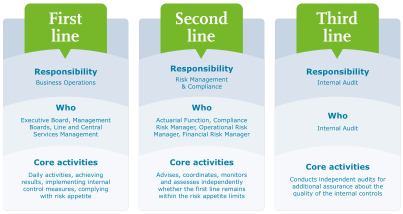
We safeguard the independence of the second and third lines so that the risk management system can function effectively.
Process
Our risk management process provides constant insight into the main risks. This process also ensures that we carefully weigh up our internal controls. The CFRO is responsible for this process.
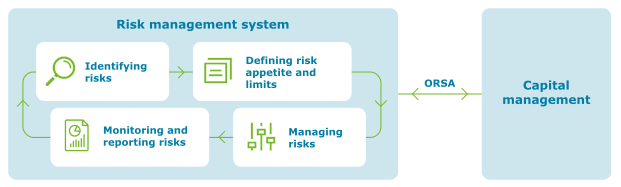
Identifying risks
We classify risks into four main categories:
- Strategic risks – choices and changes in policy, market, or organisation
- Financial risks – fluctuations in financial markets and insurance trends
- Operational risks – errors, operational risks, incidents or the failure of processes
- Integrity risks – non-compliance with laws and regulations
Please refer to the financial statements for more detailed information about the risks per risk category. See 'Consolidated financial statements', 'Notes to the consolidated balance sheet and income statement', '4. Risk section'.
Defining risk appetite and limits
Our risk appetite is the amount of risk that we are willing to accept in order to achieve an optimal balance between risk, return, and resilience. That balance is vital for achieving our goals and generating value for members and policyholders.
Our risk appetite per risk category is as follows:
- Strategic risks – neutral risk appetite based on solidarity and our core values, with a view to interests and prospects for stakeholders and valuable products and services for our members
- Financial risks – neutral risk appetite aimed at robust solvency and long-term value creation for our policyholders through a well-spread investment portfolio and managing financial risks
- Operational risks – neutral risk appetite aimed at managing operational risks
- Integrity risks – low risk appetite aimed at compliance with laws and regulations
In addition to our risk appetite, we work with specific risk appetite statements that include key risk indicators (KRIs) with associated risk limits and tolerances. Our KRIs show when risks increase or tighter control is required.
Risk management
Strategic risks
The aim of the strategic risks that we take is to find a good balance between growth, efficient business operations, and business continuity. Every year, we formulate specific annual targets for achieving our strategic objectives. Progress on the annual targets is monitored on a monthly basis, with the necessary adjustments.
Financial risks
The aim of taking financial risks is to achieve an optimal balance between healthy solvency, sufficient equity levels, and controllable premium increases for our policyholders. For funeral insurance, we seek to guarantee an affordable and dignified funeral for our policyholders. Therefore, we accept investment risks in this sense to achieve a return that we can preferably share with our policyholders through profit sharing to cover the service costs associated with the rising cost of funerals due to inflation. To monitor these risks and returns, we have a system of risk appetite statements that is aimed at guaranteeing the desired optimal balance.
Operational and integrity risks
The aim of controlling operational and integrity risks is to have controlled business operations and to comply with laws and regulations. We have defined the main risks and established internal controls for them, which are regularly assessed. We have a system of operational risk appetite statements in place to monitor the risks. These statements act as an early warning system. If a limit is exceeded, it can be a sign that risks are not adequately controlled and that remedial action is required or that the internal controls need to be tightened up.
Mitigating actions
Risk mitigation actions are taken to ensure the risks remain within the desired bandwidths. In most situations we use a mix of:
- terminating or outsourcing activities;
- reducing risks by taking preventative action or by increasing our internal controls;
- transferring risks via insurance/reinsurance and/or contract management;
- accepting risks that can be borne by the organisation itself.
We take extra measures if the risks exceed the limits and/or are larger than desired. Limits may only be deliberately exceeded – temporarily – if approved by the Executive Board.
Monitoring and reporting
We test the effectiveness of the internal controls every six months. That gives us a picture of our net risk positions, so we can assess whether the risks remain within the limits of our risk appetite. Every three months as well, we test whether the risk limits and tolerances (KRIs) have been exceeded.
The basic idea is to reduce risks that exceed our risk appetite to a lower risk level by using a mix of risk mitigation solutions. Additional actions are defined if limits are exceeded. If a KRI limit is exceeded, it is a sign that a risk has manifested itself. That can be a reason to take remedial action or to tighten up the internal controls.
Management regularly goes through the Risk Control Self Assessment (RCSA) process. That results in an 'in control statement' (ICS). In addition, the Internal Audit department evaluates the design and effectiveness of the risk management system.
Own risk and solvency assessment
As part of Solvency II, we achieve a proper balance between risk, capital, and strategy. The own risk and solvency assessment (ORSA) covers that process. This involves reviewing our company objectives, risk appetite, and available capital buffers in relation to various scenarios (stress scenarios). These scenarios are defined by the Executive Board prior to the ORSA, with advice from the second line. We record the findings in an ORSA report.
Findings in the ORSA
- Our solvency is robust.
- The coverage ratio in the basic scenario shows a gradual increase.
- Adjustment is necessary in environments with low interest rates and low inflation.
- Climate stress scenarios show that the sensitivity of our financial position to physical and transition risks is limited.
In short: our capital and our risk structure are solid, with an emphasis on future vulnerabilities.
Capital management
Our capital policy is aimed at maintaining a sound solvency position. We constantly strive for a good balance between the amount of capital we maintain and the risks we face. We have developed an internal minimum solvency capital requirement. In this framework, we have defined an internal minimum solvency capital requirement which we always aim to exceed. The internal minimum solvency capital requirement for each licensed entity (DELA Coöperatie and DELA Natura) has been established at 150 per cent.
The capital policy defines various actions should the solvency ratio drop below the internal minimum solvency capital requirement. The solvency ratio was constantly higher than the solvency requirement during 2025.
Developments in 2025
In 2025, we evaluated the risk appetite statements and optimised them where necessary. In this section, we discuss the risks faced in 2025 and the measures we took to limit their probability and/or impact. We also look at the general measures that we took to reduce risks.
Strategic risks
Strategic risks can obstruct us in achieving our long-term goals. Regular review of our strategy contributes to the reduction of strategic risks. In 2025, we worked on a new long-term business plan for 2026-2030, which will be implemented in tandem with organisational transformation. Starting in 2026, we will organise ourselves primarily in business units for our insurance activities and our funeral activities.
Financial continuity is essential for implementing our strategy. Stress tests show that while our solvency position is robust, our equity position is sensitive to scenarios with low interest rates and low inflation. We take preparatory measures or make different choices where necessary. The main preconditions and actions are set out in our capital policy, which is evaluated annually. We do not maintain any required capital for strategic risks.
Financial risks
We monitor developments in the financial markets on an ongoing basis. In 2025, this resulted in extra currency hedging for our exposures to US dollars.
More detailed information on the development of the financial risks (including the associated quantification) is provided in the risk section of the financial statements.
Operational risks
Operational risks are caused by external influences, human error, and the failure of processes and systems. Despite clear processes, responsibilities, and reporting, we cannot completely eliminate these risks. The number of incidents in operational risk management are limited. It is important to learn from the past to prevent repeats in the future. The nature and scope of these incidents is very diverse, varying from fraud (or attempted fraud) and cyberattacks to operational incidents at our funeral centres. We have assessed these incidents, and we have taken additional measures where necessary.
In 2025, we continued the 'Business in Control' programme and integrated it into our regular business operations. In addition, 2025 saw completion of the centralised registration of risks and internal controls for the Dutch business; the internal controls will be regularly assessed. We also started on the centralised registration of risks and internal controls for the Belgian and German operations, where that is still performed locally.
Integrity risks
Non-compliance with laws and regulations is a risk that can threaten our continuity and tarnish our reputation. At the same time, the regulations that we must comply with continue to grow, such as the DORA requirements that took effect in 2025. There were no serious incidents related to integrity risks in 2025.
To further control the risk, in 2025 we worked on our professionalisation for a variety of topics, such as sanctions legislation. An important part of that was compliance with the current laws and regulations on sanctions.