
Notes to the company balance sheet and income statement
1. General notes
1.1 Activities
The activities of DELA Natura- en levensverzekeringen N.V. ('DELA Natura'), having its registered office in Eindhoven, Oude Stadsgracht 1, Chamber of Commerce number 17078393 consist of insurance and investing. The insurance products comprise funeral insurance, term life insurance, and savings-linked insurance. The insurance activities take place in the Netherlands, Belgium, and Germany. All investing activities for DELA Natura are conducted in the Netherlands.
1.2 Related parties
Related parties are defined as all legal entities that can be controlled, jointly controlled, or significantly influenced. Legal entities that can exercise control are also defined as related parties. The members of the Supervisory Board, the members of the Management Board under the Articles of Association, other key officers in the management of DELA Natura, and their close relatives are also related parties. The other group companies within the DELA Coöperatie U.A. group, which includes DELA Natura, are also defined as related parties.
Significant transactions with related parties are disclosed in the notes in so far as they are not entered into under normal market conditions. Their nature and extent are disclosed along with any other information necessary to provide sufficient insight. With regard to deaths reported for DELA Natura- en levensverzekeringen N.V., the arrangements are, in principle, in the hands of DELA Uitvaartverzorging N.V. or its subsidiaries. Fixed transfer prices are charged for these arrangements. Subsidiary DELA Crematoria Groep B.V. also leases crematoriums and funeral centres to DELA Uitvaartverzorging N.V. The rent is based of the required rate of return. In addition, DELA Natura has a current account relationship with DELA Holding N.V.
1.3 Consolidated figures
DELA Natura- en levensverzekeringen N.V. exercises the consolidation exemption in accordance with Article 2:408 of the Dutch Civil Code (DCC) (interim consolidation exemption). This is because the financial information that the legal entity would have to consolidate is included in the consolidated financial statements of DELA Coöperatie U.A. The financial statements, including the consolidated figures of DELA Coöperatie U.A., are available from the Chamber of Commerce.
1.4 Cash flow statement
DELA Natura exercises the exemption in RJ 360. This states that a medium or large-sized legal entity must prepare a cash flow statement unless the capital of the legal entity is directly or indirectly provided by another legal entity that prepares an equivalent cash flow statement that is included in the consolidated financial statements filed with the trade register in the Netherlands. The financial statements, including the cash flow statement of DELA Coöperatie U.A., are available from the Chamber of Commerce.
1.5 Estimates
In applying accounting policies and financial reporting requirements, the Management Board needs to make judgements and estimates that may be critical to the amounts reported in the financial statements. Where necessary to provide the insight required by DCC Article 2:362(1), the nature of these judgements and estimates, and details of the underlying assumptions, are provided in the notes to the relevant items. Although these estimates have been made by the Management Board to the best of their knowledge, the actual outcomes may ultimately vary.
The main estimates relate to:
- the valuation of investments: real estate, real estate funds, infrastructure funds, agricultural and forestry funds, and private equity companies (see also section 4.2);
- the accounting policies applied for the technical provisions (see also section 2.12);
- the valuation of the non-technical provisions (see also section 2.13);
- the valuation of deferred tax assets (see section 4.3).
1.6 Adjustment to comparative figures
It was several years ago that Yarden was acquired. This acquisition took place on 2 August 2021, and the technical provisions were measured at fair value in accordance with the purchase accounting method as at 31 July 2021. Due to a drop in interest rates between those dates, the valuation of the technical provision was too low. Before 2025, DELA had chosen not to recognise this immaterial difference. DELA has reconsidered this standpoint now and decided to recognise the difference after all. This adjustment has been made retrospectively to provide better insight into the 2025 financial statements and for comparison purposes.
In the previous year, the amounts due from intermediaries and policyholders were incorrectly recognised under 'Other receivables'. To enhance the informative value of the financial statements, we have rebalanced the figures between 'Other receivables' and 'Receivables arising out of direct insurance business'.
| Amounts x €1,000 | Financial statements 2024 | Adjustment to comparative figures | Rebalancing | Financial statements 2025 | |
|---|---|---|---|---|---|
| Adjustments in the balance sheet | |||||
| Gross technical provisions | 8,595,864 | 9,973 | 8,605,837 | ||
| Receivables arising out of direct insurance business | -290 | 3,918 | 3,628 | ||
| Other receivables (deferred tax assets: technical provision) | 196,779 | 2,573 | -3,918 | 195,434 | |
| Other reserves | 513,092 | -7,400 | 505,692 | ||
| Adjustments in the income statement | |||||
| Change in technical provisions for net account (gross) | -288,603 | 333 | -288,270 | ||
| Tax on profit on ordinary activities | 5,574 | -86 | 5,488 | ||
| Profit on ordinary activities after tax | 178,610 | 247 | 178,857 |
1.7 Preparation and adoption of the financial statements
DELA Natura- en levensverzekeringen N.V. exercises the interim consolidation exemption in accordance with DCC Article 2:408. The financial information of the company and its subsidiaries is included in the consolidated financial statements of DELA Coöperatie U.A.
The financial statements for 2025 were prepared by the management on 21 April 2026 and will, at the time of publication, have been adopted at the general meeting of 30 May 2026. The financial statements for 2024 were adopted at the general meeting of 24 May 2025.
2. Accounting policies
2.1 General
The financial statements were prepared in accordance with the statutory provisions of DCC Title 9, Book 2 and the Dutch Guidelines for Annual Reporting (Richtlijnen voor de Jaarverslaggeving, RJ), including RJ 605, which is applicable to insurers. This is based on the going-concern assumption.
Profit is measured and determined using historical costs unless stated otherwise. Income and expenses are allocated to the year to which they relate. Gains are only recognised if they were realised at the balance sheet date, unless stated otherwise. Liabilities and potential losses arising before the end of the reporting year are accounted for it they become apparent before the financial statements are prepared.
The accounting policies applied have remained unchanged since the previous year.
2.2 Foreign currency
2.2.1 Functional currency
The items in the financial statements are measured using the currency of the economic environment in which the group companies carry out the majority of their business activities (functional currency). The euro is the functional currency and the presentation currency of DELA Natura.
2.2.2 Foreign currency translation
Transactions in foreign currencies during the reporting period are recognised in the financial statements at the exchange rate on the transaction date. Assets and liabilities in foreign currencies that are stated at fair value are translated at the exchange rate as at the balance sheet date. Exchange rate differences that arise in the settlement of monetary items are recognised in the income statement in the period in which they occur.
Assets measured at historical cost in a foreign currency are translated using the exchange rate prevailing on the transaction date (or approximate exchange rate).
2.3 Reinsurance contracts
Reinsurance is utilised for our term-life insurance through a combination of quota share and excess of loss reinsurance contracts. The aim is to limit the chance of fluctuations in the operating profit. DELA Natura is compensated for losses on issued insurance contracts by contracts made with reinsurers.
Reinsurance premiums, commissions and claims as well as technical provisions for reinsurance contracts are accounted for in the same way as the direct insurance for which the reinsurance was taken out. The reinsurers' share of the technical provisions to which DELA Natura is entitled under its reinsurance contracts is deducted from the gross technical provisions. Amounts owed by reinsurers falling due within one year are entered under receivables.
Amounts due from or payable to reinsurers are measured in accordance with the conditions of the reinsurance contracts. Reinsurance liabilities primarily concern premiums payable.
Receivables arising out of reinsurance contracts are tested at the balance sheet date for any impairment.
2.4 Intangible fixed assets
Intangible fixed assets are measured at historical cost less accumulated amortisation and any impairment losses. Amortisation is taken on a straight-line basis over the useful life of the assets. Their useful life is reassessed at the end of the financial year, and the amortisation period is revised if any significant changes are detected. A statutory reserve is recognised for the costs of internal development, equivalent to the value of the capitalised amount.
See section 2.8 to determine whether an intangible fixed asset has become impaired.
2.4.1 Acquired insurance portfolios
The future cash flows from acquired insurance portfolios are measured at their fair value at the time of acquisition. Fair value is the amount that would have to be paid between knowledgeable, willing parties in an arm's length transaction. This value is amortised on a straight-line basis over its expected useful life, which is assessed annually. The current expected useful life for acquired insurance portfolios is 20 years, calculated from the acquisition date.
2.4.2. Concessions and licences
Concessions and licences are measured at historical cost and amortised on a straight-line basis over their expected useful life with a maximum of 20 years.
2.4.3. Software systems
Software development expenses are capitalised as part of the production cost if it is probable that there will be future economic benefits and the costs can be reliably measured. Investments in software systems are capitalised and amortised on a straight-line basis over their expected useful life, with a maximum of 10 years.
2.5 Investments
The accounting policy per investment category is described below. The majority of the investments are measured at fair value. Section 4 in the notes to the balance sheet item provides a more detailed explanation of fair value, if required. Both unrealised and realised gains and losses due to the sale and changes in the value of investments are recognised in the income statement. Transaction costs related to the purchase and sale of investments are recognised directly in the income statement. The purchase and sale of securities is recognised on the transaction date.
2.5.1 Participating interests
Participating interests over which significant influence can be exercised are measured using the equity method (net asset value method). In the event that 20 per cent or more of the voting rights can be exercised, it may, by law, be assumed that there is significant influence.
The net asset value is calculated in accordance with the accounting policies that apply to these financial statements; for participating interests about which there is not enough information available for alignment with these policies, the accounting policies of the relevant participating interest prevail.
If the measurement of a participating interest based on net asset value is negative, it will be stated at nil. If and in so far as DELA Natura can be held fully or partially liable for the debts of the participating interest, a provision is recognised for this. Participating interests are recognised initially at the fair value of the identifiable assets and liabilities on acquisition and subsequently on the basis of the accounting policies used for these financial statements using this initial value as a basis.
Participating interests where no significant influence can be exercised are measured at historical cost. In the event of permanent impairment, the item is carried at the recoverable amount. Impairment losses are charged to the income statement.
Amounts owed by participating interests recognised under financial fixed assets are measured at the fair value of the amount provided, which is normally its nominal value, less any provisions deemed necessary.
2.5.2 Shares and other variable-yield securities
Shares are measured at fair value based on official listings in the financial markets. Changes in value are recognised directly in the income statement.
2.5.3 Bonds and other fixed-income securities
Bonds are measured at fair value based on official listings in the financial markets.
2.5.4 Mortgage loan receivables
Mortgage loan receivables are measured at amortised cost. The direct costs related to the provision of a mortgage loan are included as purchase costs. They are part of the amortised cost and are capitalised in the balance sheet. An assessment will be made at the balance sheet date as to whether there is any objective evidence that the mortgage loan receivables are impaired. The loss is recognised in the income statement if this proves to be the case.
2.5.5 Derivatives
DELA Natura has forward exchange contracts that are measured at fair value. The gain or loss from the revaluation into fair value at the balance sheet date is immediately recognised in the income statement. This concerns unquoted assets, which are measured using financial models: the mark-to-model method. Any derivative financial instruments with a negative value are categorised in the balance sheet under accruals and deferred income.
2.5.6 Other loan receivables
Investments in business loans are measured at fair value.
Other loans have a fixed interest rate and are measured at amortised cost less a provision for doubtful debts.
2.5.7 Real estate, infrastructure, agricultural and forestry funds
Investments in real estate funds, infrastructure funds, and agricultural and forestry funds are measured at fair value. This item contains investments without a frequent quotation. Section 4.2 provides more detailed information on the valuation method. Changes in value are recognised directly in the income statement. A revaluation reserve is recognised for the accumulated unrealised positive value, taking account of deferred taxes.
2.5.8 Mortgage funds
Investments in mortgage funds are measured at fair value. This item contains investments without a frequent quotation. Section 4.2 provides more detailed information on the valuation method. Changes in value are recognised directly in the income statement. A revaluation reserve is recognised for the accumulated unrealised positive value at fund level, taking account of deferred taxes.
2.5.9 Investments in cash and cash equivalents
Investments in cash and cash equivalents are measured at fair value, which is the same as their nominal value.
2.5.10 Other financial investments
Other financial investments are measured at fair value. This item contains investments without a frequent quotation. Section 5.2 provides more detailed information on the valuation method. Changes in value are recognised directly in the income statement. A revaluation reserve is recognised for the accumulated unrealised positive value, taking account of deferred taxes.
2.5.11 Investment result
The items from the income statement below comprise the total investment results. Investment income allocated to the non-technical account is determined by multiplying the investment results by the ratio of the average equity to the average total equity per country.
2.5.11.1 Investment income
Investment income includes:
- rental income from investments in real estate;
- results of participating interests;
- dividends from shares;
- interest on investments in fixed-income securities;
- realised gain on the sale of investments.
Interest expense is recognised on a pro-rata time basis taking into account the effective interest rate of the relevant liabilities. Transaction costs of the loans received are taken into account when recognising interest expense.
2.5.11.2 Unrealised investment result
The unrealised result originates from changes in the value of securities and real estate.
2.5.11.3 Administration expenses and interest expense
Administration expenses and interest expense include:
- administration expenses for investments in real estate;
- administration expenses and custody fees for shares and bonds;
- interest expense.
2.5.11.4 Realised losses on investments
Realised losses on financial instruments measured at market value are recognised in the income statement.
2.6 Receivables
Receivables are measured at fair value on initial recognition and subsequently measured at amortised cost. Any provisions deemed necessary for possible losses due to doubtful debts are deducted. These provisions are determined based on an individual assessment of the amounts receivable.
Deferred tax assets are recognised for all temporary differences between the value of the assets and liabilities under tax regulations and the accounting policies used in these financial statements. In addition, a deferred tax asset has been recognised for losses that can be carried forward. Deferred tax assets are recognised if it is deemed probable that sufficient future taxable profit will be available. The calculation of deferred tax assets at nominal value is based on the tax rates prevailing at the end of the reporting year or the rates applicable in future years, to the extent that they have already been enacted by law or the legislative process has been substantially completed at the balance sheet date.
2.7 Tangible fixed assets
Tangible fixed assets are measured at historical cost less depreciation over their expected useful lives and taking account of any residual value. Depreciation is taken on a straight-line basis according to the following depreciation periods:
- Equipment: 10 years
- Laptops: 4 years
- IT equipment: 5 years
2.8 Impairment of fixed assets
DELA Natura assesses at the balance sheet date whether there are any indications that a fixed asset may be impaired. If so, the recoverable amount of the individual asset is determined. If the recoverable amount of an individual asset cannot be determined, the recoverable amount of the cash-generating unit to which the asset belongs is determined. This involves the use of estimates. An asset is impaired if its carrying amount exceeds its recoverable amount. The recoverable amount is the higher of an asset's net selling price and its value in use.
If it is determined that a previously recognised impairment loss no longer exists or has decreased, the impairment loss is reversed up to the carrying amount that would have been determined if no impairment loss had been recognised for the asset.
For financial instruments, DELA Natura also assesses at each balance sheet date whether there are objective indications of impairments of a financial asset or group of financial assets. In the event of such indications, the impairment loss is determined and recognised directly in the income statement.
For financial assets that were measured at redemption value, the amount of the impairment loss is determined as the difference between the asset's carrying amount and the best estimate of the future cash flows, discounted at the effective interest rate of the financial asset as determined on the initial recognition of the instrument. Any reversal of an impairment loss is limited to the amount required to measure the asset at amortised cost. The reversed loss is then recognised in the income statement. Any impairment of goodwill will not be reversed in the future.
2.9 Cash and cash equivalents
Cash and cash equivalents comprise cash in hand and bank balances. Bank overdrafts are included in payables to credit institutions in current liabilities. Cash and cash equivalents are measured at nominal value.
2.10 Prepayments and accrued income
Receivables are measured at fair value on initial recognition and subsequently measured at amortised cost. The fair value of the amortised cost equals the nominal value. Any provisions deemed necessary for possible losses due to doubtful debts are deducted.
2.11 Profit share
Whether and how a share of the profit is granted under the terms of the DELA Uitvaartplan is determined by the general meeting of Coöperatie DELA on the recommendation of the Executive Board. The balance between healthy solvency, sufficient equity levels, and profit sharing is important in this decision for the financial health of our cooperative. The amount of the profit share is calculated on an actuarial basis. The amount of the annual profit share is determined by the Executive Board itself within the principles agreed with the general meeting. If a different profit share is proposed, it must be approved by the general meeting on the recommendation of the Executive Board. The profit share, if any, is then recognised via the technical provisions. The addition of the amount that DELA Natura has appropriated for profit sharing in respect of the technical provisions is charged to the profit.
2.12 Technical provisions
2.12.1 General
Determining the technical provisions is a process that by its very nature involves uncertainties. The actual claims depend on factors such as social, economic and demographic trends, inflation, investment returns, the behaviour of policyholders and assumptions about changes in mortality. Any use of different assumptions for these factors than the actuarial policies used to determine rates currently applied in the financial statements could have a material effect on the technical provisions and underwriting expenses (see also 4.8.1: liability adequacy test).
2.12.2 Funeral insurance
For claims under insurance policies that are expected to be paid in the future, a liability is recognised as soon as the policy takes effect. The funeral insurance liabilities for our own account and risk consist of the discounted (at actuarial interest) value of the expected (based on actuarial mortality) future claims (including recognised profit share) payable to policyholders or other beneficiaries, less future premiums.
The technical provision for DELA UitvaartPlan is calculated in accordance with the pure net method at an interest rate of 2.75 per cent and based on the GBM/V 1995-2000 mortality table published by the Dutch Actuarial Association (Actuarieel Genootschap), using the mortality and interest bases. For insurance policies with temporary premium payments, the actuarial interest rate for the period after the end date for the payment of premiums is 2 per cent.
The technical provisions for the Yarden portfolio acquired in 2021 are based on accounting policies used for measurement at fair value on the acquisition date. The actuarial interest rate is 1.3 per cent on average, and the mortality rate is based on the 2020 life expectancy table published by the Dutch Actuarial Association. Lapses and surrenders were also taken into account at the time of acquisition based on historical figures and the current cost level. In addition, there is an additional provision regarding the Yarden portfolio: At the time of the acquisition, DELA guaranteed that bereaved families will not have to pay inflation deficits for the first ten years after the acquisition. These deficits are estimated at the time of acquisition and discounted, resulting in the fair value of this commitment.
Most of the technical provision for funeral insurance for our own account and risk as taken out in Belgium is calculated in accordance with the pure net method based on the usual interest rates and life expectancy tables at the time that the policies took effect and using the mortality and interest rate bases. The expected claims are based on the actuarial rate policies as determined when taking out the policy.
The technical provision for DELA Sorgenfrei Leben is calculated using the pure net method at an interest rate of 2 per cent. The mortality rates are based on mortality tables published by the German Association of Actuaries (Deutsche Aktuarvereinigung, DAV).
The technical provisions in the insurance portfolio acquired in Germany in 2022 are based on accounting policies used for measurement at fair value on the acquisition date. The actuarial interest rate is 2.5 per cent on average, and the mortality rate is based on the 2022 life expectancy table published by the Dutch Actuarial Association.
2.12.3 Term life insurance
The technical provision for the DELA LeefdoorPlan (life insurance plan) is calculated in accordance with the pure net method at an interest rate of 3 per cent and based on the life expectancy tables published by the Dutch Actuarial Association when the actuarial rate was introduced.
The technical provision for DELA Activ Leben is calculated in accordance with the pure net method at an interest rate of 3 per cent. The mortality rates are based on mortality tables published by the German Association of Actuaries.
2.12.4 Savings-linked insurance
The technical provision for the DELA CoöperatiespaarPlan (savings plan) is calculated in accordance with the built-up surrender value based on the savings premiums paid, the recognised profit shares and the interest rate associated with the actuarial rate.
2.12.5 Premiums
The premiums include surcharges to cover costs. When the premiums are received or become collectable, the surcharges are released and made available for the coverage of the actual costs, which includes ongoing costs and acquisition costs.
2.12.6 Acquisition costs
The deferred acquisition costs are deducted from the provision.
2.13 Provisions
2.13.1 General
Provisions are recognised for legally enforceable or constructive obligations that exist at the balance sheet date and for which it is probable that an outflow of resources will be required, and a reliable estimate can be made.
Provisions are measured at the best estimate of the amount that is necessary to settle the obligations as at the balance sheet date. Provisions are measured at the present value of the expenditure expected to be needed to settle the obligations, unless stated otherwise.
If obligations are expected to be reimbursed by a third party, such reimbursement is recognised as an asset in the balance sheet if it is probable that such reimbursement will be received when the obligation is settled.
2.13.2 Provision for anniversaries
The provision for anniversaries is included for expected long-service awards during the course of employment (25 years and 40 years of service) and for when employees reach retirement age. The probability of future employee outflow is taken into account when determining the provision. This is based on historical figures. The impact of wage inflation and discounting is not taken into account in the expected awards as this is immaterial on balance.
2.13.3 Deferred tax liabilities
For any tax amounts to be paid in the future resulting from differences between commercial and tax balance sheet valuations, a provision is recognised for the amount of these differences multiplied by the applicable tax rate. The provision for deferred tax liabilities is measured at nominal value.
The calculation of deferred tax liabilities is based on the tax rates prevailing at the end of the reporting year or the rates applicable in future years, to the extent that they have already been enacted by law or the legislative process has been substantially completed at the balance sheet date.
2.14 Liabilities
Liabilities are measured at fair value on initial recognition, which at that time is the same as amortised cost. Directly attributable transaction costs are included in the measurement on initial recognition. Liabilities are subsequently measured at amortised cost, which is the amount received, taking into account the premium or discount and less transaction costs. If there is no premium or discount, this amount is the same as their nominal value.
The difference between the carrying amount and the ultimate redemption value is charged to the income statement as interest expense over the estimated term of the liability based on the effective interest rate.
2.15 Accruals and deferred income
Accruals and deferred income are measured at fair value on initial recognition and subsequently measured at amortised cost.
2.16 Leasing
DELA Natura does not have any financial lease contracts. Lease contracts that do not qualify as a financial lease are recognised as operational leases. Operational lease payments are recognised on a straight-line basis in the income statement for the term of the lease.
2.17 Revenue recognition
2.17.1 Premium income
The gross premiums consist of the premiums that are payable by policyholders for insurance contracts. The gross premiums excluding taxes and other fees resulting from insurance contracts are recognised as income when they are due by the policyholder. For single premium contracts the premium is recognised as income when it is due, with any cost and risk coverages being postponed and recognised in the result at a constant proportion to the ongoing insurance.
2.17.2 Reinsurance premiums
The reinsurance premiums comprise the premiums for reinsurance contracts. They are recognised in the income statement as an expense.
2.18 Operating costs
2.18.1 Acquisition costs
Acquisition costs are costs directly related to taking out insurance policies, which depend on and relate to the acquisition of new insurance contracts or the extension of existing ones. Acquisition costs consist of commissions paid to third parties for insurance products. The acquisition costs are deducted from the technical provision and expensed over ten years. The annual commissions are offset by the commissions recovered throughout the year. The amortisation period is regularly assessed. Where applicable, the amortisation charges are adapted to the shorter amortisation period.
The liability adequacy test is an annual assessment of whether the technical provision less the deferred acquisition costs and VOBA (Value of Business Acquired) is sufficient to provide a high degree of certainty regarding future amounts payable to policyholders. If this test leads to the conclusion that there is inadequate liquidity, the deferred acquisition costs are initially expensed in so far as necessary.
2.18.2 Administration expenses
Administration expenses are costs that are not acquisition costs, staff costs or depreciation and amortisation.
2.18.3 Staff costs
Wages, salaries, and social security contributions are recognised in the income statement when they are due for payment to employees and the tax authorities. The pension schemes are described in the following sections.
2.18.3.1 Pension scheme in the Netherlands
The pension scheme of the group companies in the Netherlands consists of a defined contribution scheme in which members build up a capital sum that they must use to purchase pension benefits at the time of their retirement.
The main features of this scheme are as follows:
- The employer pays a monthly contribution for each employee to the pension provider;
- The pensionable salary is 1.1666 times the full-time monthly salary paid in a calendar month, with an annual maximum (2025: €137,800);
- The pensionable earnings over which the employer pays contributions comprise the pensionable salary less the contribution-free amount (2025: €18,475);
- The pension contributions paid to the pension provider for everyone who joined the company after 1 January 2022 amount to 22 per cent of the pensionable earnings. The pension contributions paid to the pension provider for those who joined the company prior to that date is based on an age table with rising contribution rates.
- Persons employed from 1 January 2022 pay an individual contribution of 6 per cent of the pensionable earnings, while those employed before that date pay 4.5 per cent.
- The scheme does not result in any liability at the balance sheet date, with the exception of liabilities for future contribution payments.
Members are also insured for a dependant's pension of 1.16 per cent of the pensionable earnings multiplied by the number of years of service from when they joined the pension scheme up to the target retirement date. The orphan's pension is 20 per cent of the dependant's pension. The payment of contributions is waived for members who become incapacitated for work.
In addition, a supplemental incapacity for work benefit is covered, with the amount of the benefit depending on the degree of incapacity.
Pension schemes in the Netherlands are governed by the Dutch Pensions Act (Pensioenwet). DELA Natura pays contributions to insurance companies on a mandatory, contractual or voluntary basis. The contributions are accounted for as staff costs as soon as they are due. Contributions paid in advance are recognised as a prepayment if these lead to a refund or reduction of future payments. Contributions due but not yet paid are recognised in the balance sheet as liabilities.
2.18.3.2 Pension scheme in Belgium
In Belgium, we have a defined contribution scheme. Upon retirement, members can choose to receive a lump sum payment or convert their capital into a regular pension benefit. The main characteristics of this pension scheme are as follows:
- The employer pays a monthly contribution to the pension provider;
- The contribution is 4 per cent of the reference salary and 13 per cent of the salary above the reference salary, plus 4.4 per cent tax;
- The reference salary is 13.92 times the gross monthly salary, with a maximum of €80,485.
Employees also receive term life insurance where the surviving dependants receive a death benefit lump sum if the employee dies before the end date. In the event of incapacity for work due to sickness, pregnancy, or a personal accident, the insured person receives replacement income.
2.18.3.3 Pension scheme in Germany
The statutory pension contributions in Germany are paid via monthly social security contributions. There is no additional company pension.
2.18.4 Amortisation
Intangible and tangible fixed assets are amortised/depreciated over the expected future useful life of the asset from the time it is put into use. Land is not depreciated. Future amortisation/depreciation is adjusted accordingly if there is a change in the asset's useful life. Gains and losses recognised on the occasional sale of tangible fixed assets are included in the exceptional income and expenses.
2.19 Other income and expenses
Other income and expenses are revenues and costs that arise from activities other than insurance and investment or that are non-recurring.
2.20 Taxes
The tax on profit is calculated on the profit before tax in the income statement, taking into account any tax losses carried forward (in so far as they are not included in the deferred tax assets) and exempt profit components, and after adding non-deductible expenses. Future changes to the applicable tax rate are also taken into account.
Management regularly assesses the positions taken in the tax returns in situations where tax law allows room for interpretation and makes provisions where necessary for amounts that it expects will need to be paid to the local tax authorities.
In relation to the legislation on Pillar 2 income taxes, DELA Group has exercised the mandatory exception based on RJ statement 2023-14 regarding the treatment of deferred tax assets and liabilities related to Pillar 2 income taxes.
3. Risk section
3.1 Solvency position
The solvency position of DELA Natura is determined using the standard model in Solvency II. The internal minimum solvency capital requirement for DELA Natura has been established at 150 per cent.
The Solvency II ratio saw a slight increase in 2025 as a result of changes in interest rates, inflation and the coverage ratio. Stress tests show that the solvency position is robust, although DELA Natura is sensitive to scenarios with low interest rates and low inflation.
3.1.1 Development of solvency capital requirement
The composition of the capital requirement is illustrated by the diagram below.
Composition of SCR
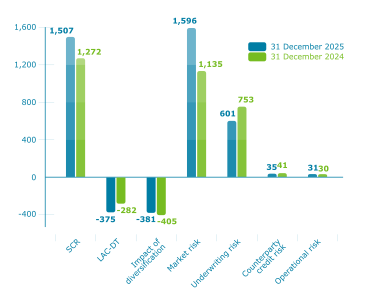
LAC-DT = Loss Absorbing Capacity of Deferred Taxes
The SCR saw an increase, which was primarily due to market risks. It is clear that the underwriting risks and market risks are the greatest risks. The market risks increased, compared with a decrease in the underwriting risks. This is explained in more detail in section 3.2.1.
3.1.2 Development of own funds
In 2025, the own funds (these are the own funds in the Solvency II balance sheet) increased on the back of a decrease in the value of the technical provisions. This was driven by the higher interest rates and because more expenses were allocated to the coverage ratio in line with Solvency II. The composition of own funds is illustrated by the diagram below (amounts in € million).
Composition of own funds
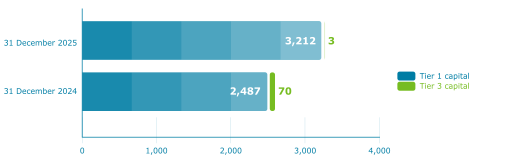
Similar to last year, the own funds consists almost entirely of tier 1 capital. All basic tier 1 items are fully at DELA's disposal.
3.2 Risk profile
DELA Natura is exposed to strategic risks, market risks, underwriting risks, operational risks, integrity risks, and reputation risks. The governance section of the report of the Management Board sets out the main risk areas. It also describes the developments in 2025 regarding the main risks.
The various risks are explained in more detail in the sections below. For improved readability, not all risks are described in detail, and some are combined.
Sustainability-related risks materialise in the event of market risks in particular and are part of the risk categories discussed in the following sections.
Similar to last year, the own funds consists almost entirely of tier 1 capital. All basic tier 1 items are fully at DELA's disposal.
3.2.1. Financial risks
Financial risks include market risks, underwriting risks, credit risk and liquidity risk.
3.2.1.1 Market risks
The market risk is the risk of possible losses due to adverse developments in the financial markets. The value of the investments and the value of the liabilities depend on developments in these markets, the composition of the investment portfolio and the characteristics of the insurance liabilities.
DELA Natura has mitigated the market risk to a significant extent through its profit sharing scheme and premium action, as well as via derivatives that mitigate part of the currency risk. DELA Natura applies the 'prudent person' principle to its investment policy, and full and/or partial ALM studies are regularly performed to assess whether the investment policy is still suitable.
The table below shows the development of the market risk, quantified using the standard model shown (amounts in € million).
Market risk development
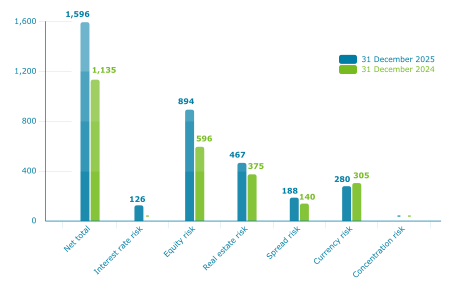
The share risk increased because of the higher percentage that must be maintained for this risk (symmetric adjustment). Because of the lower value of the profit sharing option, profit sharing had less of a mitigating effect, prompting a slight increase in all market risks, including the interest rate risk. On the other hand, the currency risk decreased because of the increased cover on the currency risk for the US dollar.
Market risks are driven in part by climate change. Climate scenario analyses show that the risks associated with climate change can result in a slightly higher increase in premiums. Solvency remains stable across the various climate scenarios.
No market risk limits were exceeded in 2025.
3.2.1.2 Underwriting risks
The underwriting risk is the risk that the size and timing of claims and/or expenses are not consistent with expectations. DELA Natura mitigates the underwriting risk in various ways, such as its profit sharing scheme and premium action, but also via reinsurance, acceptance (medical), and a continuous focus on costs.
DELA Natura is exposed to the life insurance risk only as it only provides life insurance. DELA Natura's portfolio largely consists of funeral insurance, with separate rates for the Netherlands, Belgium, and Germany. These rates are based on specific characteristics and assumptions (actuarial interest, costs, life expectancy tables) aligned to each country. An annual review is conducted to assess whether these assumptions align with the development of the relevant portfolios. The portfolio is large in numbers and size, which reduces fluctuations in the results.
In addition, DELA Natura markets a term life insurance policy in the Netherlands and Germany. The sums insured in that policy are significantly higher than in the funeral insurance. Reinsurance is used to limit any volatility of the results for this portfolio.
Finally, DELA Natura has a savings-linked product in the Netherlands. The mortality risk in this portfolio is limited at 10 per cent of the accumulated value.
The diagram below illustrates the composition of the underwriting risk (amounts in € million).
Composition of underwriting risk
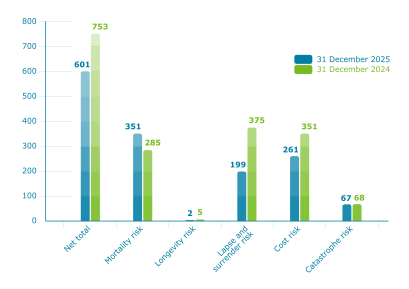
The underwriting risks decreased on balance, with various developments providing a changing picture of the underlying risks.
All underwriting risks increased as the mitigating effect of profit sharing decreased due to the lower option value of the profit share. This was compensated for in whole or part by the decrease in the technical provisions due to the higher interest rates, which means the exposure for underwriting risks was also lower. The composition of the technical provision changed due to the higher interest rates, leading to a decrease in the risk of lapses and surrenders. The cost risk decreased as well because more expenses were allocated to the coverage ratio, which means that profit sharing had more of a mitigating effect on the cost risk.
The standard model does not include the funeral cost inflation risk. Although this risk is borne by policyholders, it remains significant as an increase in funeral costs leads directly to higher premiums. DELA Natura aims to provide excellent services to its members for the lowest possible premium, and this is a special focus in the own risk and solvency assessment (ORSA). DELA Natura has some influence over the development of the rising cost of funerals due to inflation and closely monitors this trend throughout the year.
No underwriting risk limits were exceeded in 2025.
3.2.1.3 Credit risk
Credit risk (or: counterparty credit risk) is the risk of losses due to an unexpected default or unexpected worsening of the credit rating of the counterparties. This mainly involves amounts receivable related to mortgages, reinsurers, derivatives, and other debtors. In 2025, the size of the credit risk decreased to €35 million. Credit risk is not a material risk for DELA Natura.
No credit risk limits were exceeded in 2025.
3.2.1.4 Liquidity risk
This is the risk that DELA Natura is unable to fulfil its financial obligations to its policyholders or other creditors at any time because assets cannot be traded quickly enough. The liquidity risk is not expressed as a solvency capital requirement (SCR) in Solvency II. DELA Natura must have sufficient cash and cash equivalents to pay claims arising from the existing insurance contracts and to pay for its other annual expenses. DELA Natura can avail itself of credit facilities from the custodian of the shares and bonds or sell part of the liquid investments. DELA Natura fulfilled its financial obligations to policyholders and other creditors in 2025.
No liquidity risk limits were exceeded in 2025.
3.2.2 Operational risks
In addition to financial risks, DELA Natura also faces operational risks. These are risks resulting from external influences related to human error and the failure of processes and systems. The capital to be maintained for operational risks is limited compared to financial risks; it saw a slight increase in 2025.
Operational risk limits were exceeded in 2025 in the area of outsourcing. As a result, the responsible management initiated suitable action to return the risks to the desired level as quickly as possible. In addition, several activities for the implementation of DORA will continue in 2026.
Operational risks arise at all levels of the organisation. The main operational risk areas are explained in more detail below.
3.2.2.1 Internal and external fraud
DELA Natura distinguishes between internal and external fraud risks. Internal fraud is that committed by DELA Natura employees who undertake unauthorised activities to enrich themselves and by doing so harm DELA Natura. Examples are embezzlement, unjustified expense claims, deliberately incorrect time reports, etc. External fraud is committed by someone from outside of DELA Natura (third parties, suppliers, customers, etc.) whose unauthorised activities impact DELA Natura. A second line compliance manager is responsible for the anti-fraud policy and for boosting awareness. The internal controls for fraud risks are tested on a quarterly basis.
3.2.2.2 Working conditions and safety
The risks included here involve losses due to acts that are inconsistent with the laws on working conditions, health or safety, or as a result of events related to inequality or discrimination.
3.2.2.3 System failure and process management
This concerns risks of disruptions to business activities due to system failure, including cyber risks and information security. The risk of losses due to the failure of transaction processing or process management or relationships with suppliers is also included.
3.2.2.4 Financial reporting
This includes reporting on risks and uncertainties with an impact on the reliability of the internal and external financial reporting. Among other things, this concerns uncertainties and the degree of subjectivity in complex valuations and risks of the failure of financial models and/or financial accounting systems. Internal controls are in place for these risks and are tested on a quarterly basis.
3.2.3 Integrity risks
Integrity risks go hand in hand with the threat to the reputation of, or the current or future threat to the capital or the profitability of a company due to insufficient compliance with the rules that are in force under or pursuant to any laws. In principle, DELA Natura monitors this issue from its compliance function based on the topics in the systematic integrity risk analysis (SIRA). No capital is maintained for this risk.
The SIRA topics are as follows:
- Organisational and employee integrity: organisational integrity includes topics such as governance and outsourcing. Employee integrity concerns the integrity of the management, the internal supervisory body, and internal and external employees. Related subjects are pre-employment screening, skills and conflicts of interest.
- Customer chain integrity: this concerns both the integrity of customers and how the organisation treats customers. It includes the integrity of the chain in which the company operates. Topics range from duty of care to combatting money laundering and terrorism financing.
- Market integrity: this concerns the integrity of the financial and other markets, including issues such as competition and market abuse.
- Integrity related to the processing of personal data: this involves the integrity of the data used within DELA Natura (such as the processing and security of personal data).
- Tax integrity: this concerns the subtopics of tax governance and transfer pricing, VAT, payroll tax and corporation tax.
Integrity risk limits were exceeded twice in 2025. These were in the area of customer chain integrity and employee integrity. The responsible management initiated suitable action to return the risks to the desired level as quickly as possible.
3.2.4 Strategic risks
This involves uncertainties that may impede implementation of the long-term strategy. These risks may hinder expansion abroad or restrict the ability to keep to the business model with a profit sharing goal. These risks can largely be minimised via a proper strategy process, guided by external consultants and monitored by the Supervisory Board. Implementation involves business cases to assess the required investments and keep them manageable. In addition, the ORSA is used to analyse which risks are a potential threat to the continuity of DELA Natura. Stress tests show that the solvency position is robust, although DELA Natura is sensitive to scenarios with low interest rates and low inflation. Preparatory measures are taken or different choices made where necessary. The main preconditions and actions are set out in the capital policy, which is evaluated annually. No capital is maintained for strategic risks.
External trends that may impact the strategy are constantly monitored and included in the ongoing strategy process.
No strategic risk limits were exceeded in 2025.
3.2.5 Reputation risk
The reputation risk is the threat of any damage caused by a loss of reputation. Reputation loss may occur as a result of incidents related to the risk categories as described in the risk profile and is controlled by the active development of reputation management, with incident management being a major spearhead. This involves the timely identification of possible reputation risks and any associated spill-over effects, and taking timely management actions where necessary. The company culture and desired tone at the top are other important factors in mitigating this risk. They are supported by training programmes, the administrative organisation, and internal control. No capital is maintained for reputation risk.
No incidents occurred in 2025 that significantly harmed our reputation.
4. Notes to the balance sheet
4.1 Intangible fixed assets
Intangible fixed assets, movements
| Amounts x €1,000 | 2025 | 2024 | |
|---|---|---|---|
| Balance at 1 January | 75,769 | 65,565 | |
| Investments | 17,490 | 19,253 | |
| Amortisation | -12,143 | -9,049 | |
| Balance at 31 December | 81,116 | 75,769 | |
| Historical costs | 164,775 | 149,865 | |
| Accumulated changes in value and amortisation | -83,659 | -74,096 | |
| Balance at 31 December | 81,116 | 75,769 |
Intangible fixed assets, specification
| Amounts x €1,000 | Proprietary software | Software purchased externally | Acquired insurance portfolios | Other | Total |
|---|---|---|---|---|---|
| Balance at 1 January 2025 | 21,737 | 45,029 | 8,390 | 613 | 75,769 |
| Investments | 6,132 | 11,358 | - | - | 17,490 |
| Amortisation | -5,749 | -5,478 | -610 | -306 | -12,143 |
| Balance at 31 December 2025 | 22,120 | 50,909 | 7,780 | 307 | 81,116 |
| Historical costs | 35,788 | 82,389 | 40,471 | 6,127 | 164,775 |
| Accumulated changes in value and amortisation | -13,668 | -31,480 | -32,691 | -5,820 | -83,659 |
| Balance at 31 December 2025 | 22,120 | 50,909 | 7,780 | 307 | 81,116 |
The development costs charged to the profit equal the amortisation of proprietary software in the amount of €5,749.
4.2 Investments
DELA Natura manages risk positions using regular asset and liability management (ALM) studies as it aims to achieve long-term investment results that exceed the interest liabilities arising out of insurance contracts and deposits and to achieve the profit sharing goals as much as possible. The main investment goal in the insurance activities is to maximise the investment return within the approved risk framework.
4.2.1 Participating interests in group companies and participating interests
Participating interests, specification
| Amounts x €1,000 | Share in issued capital | 31-12-2025 | 31-12-2024 |
|---|---|---|---|
| DELA US Investments B.V., Eindhoven | 100% | 607,235 | 673,143 |
| DELA Crematoria Groep B.V., Eindhoven | 100% | 344,833 | 338,264 |
| DELA Hypotheken B.V., Capelle a/d IJssel | 100% | 133,271 | 155,901 |
| DELA Vastgoed B.V., Eindhoven | 100% | 78,807 | 74,320 |
| DELA Vastgoed België N.V., Liege | 100% | 59,915 | 58,274 |
| Dela Enterprises N.V., Antwerp | 100% | 1,720 | 1,720 |
| Balance at 31 December | 1,225,781 | 1,301,622 |
DELA Crematoria Groep B.V. and DELA Vastgoed België N.V. have real estate in the balance sheet. The valuation of real estate includes estimates. This means there is a certain degree of uncertainty, so a bandwidth should always be taken into account in the valuation. The accuracy of an appraisal is deemed to be within a 10 per cent range (+/ -) of the value.
DELA Vastgoed B.V. also has real estate in the balance sheet. The value of DELA Vastgoed B.V. has been determined on the basis of the unconditional contract of sale that was signed as at 24-11-2025. The property will be transferred in financial year 2026.
Participating interests, movements
| Amounts x €1,000 | 2025 | 2024 | |
|---|---|---|---|
| Balance at 1 January | 1,301,622 | 1,379,365 | |
| Result of participation interests | -23,841 | 41,935 | |
| Investments | - | 155,000 | |
| Dividend | -52,000 | -225,000 | |
| Disposals | - | -49,678 | |
| Balance at 31 December | 1,225,781 | 1,301,622 |
Loans to and amounts owed by group companies, specification
| Amounts x €1,000 | 31-12-2025 | 31-12-2024 | |
|---|---|---|---|
| Current account with group companies | |||
| - DELA Holding N.V., Eindhoven | 69,564 | 83,770 | |
| - DELA Vastgoed België N.V., Liege | 10,959 | 8,558 | |
| - DELA US Investments B.V., Eindhoven | 2,923 | ||
| - DELA Crematoria Groep B.V., Eindhoven | 2,240 | 5,867 | |
| - DELA Holding Belgium N.V., Antwerp | 256 | ||
| Total | 85,942 | 98,195 |
Interest at a rate of 3.8 per cent is calculated on the average balance of these current accounts. There are no arrangements on repayment or collateral.
4.2.2 Other financial investments
Other financial investments, movements
| Amounts x €1,000 | Position at year-end 2024 | Acquisitions | Disposals and repayments | Revaluations | Position at year-end 2025 |
|---|---|---|---|---|---|
| Shares and other variable-yield securities | 2,156,410 | 1,582,709 | -1,660,478 | 235,616 | 2,314,257 |
| Bonds and other fixed income securities | 2,699,085 | 960,892 | -826,386 | -90,305 | 2,743,286 |
| Derivatives | - | - | -219,442 | 231,156 | 11,714 |
| Mortgage loan receivables | 951 | - | -96 | - | 855 |
| Other loan receivables | 252,031 | 143,966 | -123,561 | -5,684 | 266,752 |
| Real estate funds | 1,371,938 | 81,402 | -129,472 | 2,794 | 1,326,662 |
| Infrastructure funds | 1,034,135 | 170,895 | -8,048 | -30,627 | 1,166,355 |
| Agricultural and forestry funds | 334,320 | 26,201 | - | -5,889 | 354,632 |
| Mortgage funds | 411,385 | 236,521 | - | -10,254 | 637,652 |
| Investments in cash and cash equivalents | 57,694 | 45,532 | -63,298 | - | 39,928 |
| Other financial investments | 84,609 | 69,300 | -7,194 | 4,703 | 151,418 |
| Total | 8,402,558 | 3,317,418 | -3,037,975 | 331,510 | 9,013,511 |
Other financial investments, valuations
| Amounts x €1,000 | Carrying amount | Cost | Market value | ||
|---|---|---|---|---|---|
| Shares and other variable-yield securities | 2,314,257 | 1,956,562 | 2,314,257 | ||
| Bonds and other fixed income securities | 2,743,286 | 2,831,141 | 2,743,286 | ||
| Derivatives | 11,714 | - | 11,714 | ||
| Mortgage loan receivables | 855 | 855 | 855 | ||
| Other loan receivables | 266,752 | 249,713 | 266,752 | ||
| Real estate funds | 1,326,662 | 1,398,102 | 1,326,662 | ||
| Infrastructure funds | 1,166,355 | 1,063,368 | 1,166,355 | ||
| Agricultural and forestry funds | 354,632 | 339,037 | 354,632 | ||
| Mortgage funds | 637,652 | 681,974 | 637,652 | ||
| Investments in cash and cash equivalents | 39,928 | 39,928 | 39,928 | ||
| Other financial investments | 151,418 | 140,754 | 151,418 | ||
| Total | 9,013,511 | 8,701,434 | 9,013,511 |
DELA Natura's investments were restructured in February 2024, with all shares, bonds, and loans being administratively sold and repurchased. This means that the original costs are no longer available in the systems. The costs listed above are based on the market value of the shares, bonds, and loans at the time of the restructuring. These are liquid investments and therefore tradable at market prices at any time. Since the valuation is based on market value, the added value of explaining historical costs is limited.
Unhedged foreign exchange positions
| Amounts x €1,000 | 31-12-2025 | 31-12-2024 | |
|---|---|---|---|
| US dollar | 319,024 | 1,268,471 | |
| South Korean won | 192,477 | 139,305 | |
| British pound | 159,207 | 143,395 | |
| New Taiwan dollar | 140,187 | 80,236 | |
| Japanese yen | 124,513 | 121,410 | |
| Indian rupee | 107,489 | 91,836 | |
| Australian dollar | 107,309 | 97,029 | |
| Mexican peso | 89,760 | 84,193 | |
| Swedish krona | 86,346 | 40,946 | |
| Canadian dollar | 80,278 | 73,196 | |
| Other | 618,322 | 719,208 | |
| Total | 2,024,912 | 2,859,224 |
Shares and bonds
All shares and bonds are listed.
The modified duration formula is used to measure interest rate sensitivity. The average modified duration of the bonds and other loans is 4.7 (2024: 4.7).
Shares, geographical distribution
| 31-12-2025 | 31-12-2024 | ||
|---|---|---|---|
| North America | 35.3% | 36.9% | |
| Asia-Pacific | 34.0% | 33.7% | |
| Europe | 26.0% | 25.3% | |
| Middle East | 2.5% | 2.4% | |
| Latin America | 2.2% | 1.8% | |
| Total | 100.0% | 100.0% |
Shares, sector distribution
| 31-12-2025 | 31-12-2024 | ||
|---|---|---|---|
| Information technology | 22.5% | 21.4% | |
| Financial institutions | 20.9% | 21.2% | |
| Industry | 13.9% | 12.1% | |
| Luxury consumer goods | 10.5% | 12.3% | |
| Health care | 8.8% | 8.6% | |
| Communication services | 7.0% | 7.4% | |
| Raw materials | 4.6% | 3.6% | |
| Consumer goods | 4.3% | 5.3% | |
| Energy | 3.2% | 3.9% | |
| Utilities | 2.3% | 1.8% | |
| Real estate | 2.0% | 2.4% | |
| Total | 100.0% | 100.0% |
Fixed-income securities, categorised by rating
| 31-12-2025 | 31-12-2024 | ||
|---|---|---|---|
| AAA | 24.4% | 26.6% | |
| AA | 12.0% | 12.9% | |
| A | 6.9% | 6.6% | |
| BBB | 19.4% | 17.9% | |
| < BBB | 27.2% | 29.4% | |
| Other | 10.1% | 6.5% | |
| Total | 100.0% | 100.0% |
Derivatives
The valuation of the derivatives (forward exchange contracts) is based on the mark-to-model approach. At year-end 2025, the average remaining term of these contracts is 67 days.
At year-end 2024, the derivatives had a negative value of €95.5 million; these were shown in the balance sheet under the accruals and deferred income.
Real estate funds
The real estate funds are unlisted. The real estate funds are measured at their fair value based on the DCF method. This value is provided by the fund managers and represents the valuation method that is also used when trading properties. Valuation is in accordance with generally accepted valuation methods. It is performed by an external valuer/valuator. We receive an ISAE3402 Type II report or equivalent for most funds. For all real estate funds, an independent auditor's report on the valuation or financial statements – or a status update on the audit if the report is not yet available – is received before the financial statements of DELA Natura are adopted. This provides sufficient confidence in the reliability of the valuations reported by the fund managers. A limited level of estimation uncertainty is inherent in the investments held by the fund.
Infrastructure funds and agricultural and forestry funds
The infrastructure funds and agricultural and forestry funds are unlisted. The valuation of the funds is based on the fair value provided by the fund managers. The value of the funds is determined using the DCF method. Local accounting standards are used in their valuation, and we have determined that there are only marginal differences between them. The valuation is performed by an external valuer/valuator. We receive an ISAE3402 Type II report or equivalent for most funds. The independent auditor's report on the valuation or financial statements of some of the funds – or a status update on the audit if the report is not yet available – is not received until after the financial statements of DELA Natura have been adopted. Analysis has provided sufficient certainty about the reliability of the values reported by the fund managers, but there remains a limited degree of estimation uncertainty that is inherent in the investments held by the fund.
Mortgage fund
The mortgage fund is unlisted and consists of investments in non-NHG accredited mortgages. Their valuation is based on the fair value provided by the fund managers. The DCF method is used for the valuation of the mortgage fund. The fund applies local accounting standards, which are evaluated by DELA for applicability within its own accounting policies. The valuation is performed internally and reviewed by the fund's external auditor. We receive an ISAE3402 Type II report on this valuation. The independent auditor's report on the fund's financial statements is received before the financial statements of DELA Natura are adopted. Analysis has provided sufficient certainty about the reliability of reported values, but there remains a limited degree of estimation uncertainty that is inherent in the investments held by the fund.
Other financial investments
The amounts included in 'Other financial investments' relate to interests in unlisted private equity companies and a loan fund. At year-end 2025, the loan fund was valued at €150.1 million (2024: 73.3 million).
The market value of the private equity companies is based on the DCF method.
The loan fund is unlisted and consists of investments in business loans. The valuation of the loan fund is based on the fair value provided by the fund managers. Standards aligned with IFRS are applied in the valuation of the loan fund. DELA has established that these standards differ only marginally from DELA's own accounting policies. The valuation is performed by an external valuer. We receive an ISAE3402 Type II report from the fund. Before the financial statements of DELA Natura are adopted, DELA receives at least an independent auditor's report, providing sufficient certainty about the reliability of the reported values, but there remains a limited degree of estimation uncertainty that is inherent in the investments held by the fund.
Investments in cash and cash equivalents
Investments in cash and cash equivalents concern amounts receivable and payable directly related to the investment portfolios with a mandate issued to the asset manager.
Securities lending
DELA Natura lends shares and bonds. To limit the risk for DELA Natura, borrowers must provide collateral for the loans. Cash collateral is not allowed, and the borrowers must comply with strict requirements. To further limit the risk, the following additional restrictions are applied:
- Counterparties must have an S&P rating of at least A-;
- Collateral may only be government bonds from OECD countries with an S&P rating of at least AA-;
- The market value of the collateral must be at least 102 per cent of the market value of the securities lent;
- Shares on our engagement list are not eligible for lending. Engagement is the process by which shareholders actively exercise their rights.
The market value of the securities lent as at 31 December 2025 was €190.7 million (2024: €182.3 million). The value of the collateral is €198.2 million (2024: €188.4 million). The income from the securities lent was €0.5 million (2024: €0.4 million).
4.3 Receivables
4.3.1 Receivables arising out of direct insurance business
Due to the size and distribution of the business activities of DELA Natura, the concentration of the credit risk on the receivables arising out of direct insurance business is limited. No additional provision for credit risks was recognised on top of the usual provision for doubtful debts (€0.9 million).
4.3.2 Other receivables
Other receivables, specification
| Amounts x €1,000 | 31-12-2025 | 31-12-2024 | |
|---|---|---|---|
| Deferred tax assets | 106,767 | 128,682 | |
| Corporation tax | 4,881 | 35,941 | |
| Taxes and social security contributions | 624 | 12,006 | |
| Other receivables | 19,468 | 18,826 | |
| Total | 131,740 | 195,455 |
Except for the deferred tax assets, other receivables fall due within one year. The carrying amount of these receivables is a reasonable approximation of their fair value.
Offsetting is applied to the deferred tax positions where possible. The table below shows a specification of the various deferred positions that are presented together on the asset side of the balance sheet, which also include negative amounts due to offsetting. This concerns a net deferred tax asset with the Dutch tax authorities.
Deferred tax assets, specification
| Amounts x €1,000 | 31-12-2025 | 31-12-2024 | |
|---|---|---|---|
| Regarding other tax valuation of: | |||
| - technical provision | 92,876 | 93,161 | |
| - tax losses carried forward | 73,903 | 66,352 | |
| - Initial costs | 49,808 | 45,703 | |
| - securities | -70,936 | -30,309 | |
| - real estate | -29,185 | -48,848 | |
| - other | -9,699 | 2,623 | |
| Total | 106,767 | 128,682 |
Deferred tax assets are typically of a long-term nature. In determining whether there is a deferred tax asset, the item is assessed using projections of future taxable profits. These projections involve estimation risks. These risks primarily lie within the estimates of future investment results and future profit shares. The recoverable withholding tax (€6.3 million) has been recognised under 'tax losses carried forward'.
4.4 Tangible fixed assets
Tangible fixed assets, movements
| Amounts x €1,000 | 2025 | 2024 | |
|---|---|---|---|
| Balance at 1 January | 349 | 473 | |
| Investments | 78 | 102 | |
| Depreciation | -164 | -226 | |
| Balance at 31 December | 263 | 349 | |
| Historical costs | 1,611 | 1,533 | |
| Accumulated changes in value and amortisation | -1,348 | -1,184 | |
| Balance at 31 December | 263 | 349 |
The tangible fixed assets concern equipment and computers.
4.5 Cash and cash equivalents
Cash and cash equivalents mainly consist of freely available bank balances.
4.6 Prepayments and accrued income
Prepayments and accrued income consist of accrued interest and rent and amounts paid in advance.
4.7 Equity
Equity, movements
| Amounts x €1,000 | 2025 | 2024 | |
|---|---|---|---|
| Balance at 1 January (based on 2024 financial statements) | 914,892 | ||
| Effect of adjustment to comparative figures in 2025 financial statements | -7,647 | ||
| Balance at 1 January (after adjustment) | 1,087,764 | 907,245 | |
| Profit after tax | 115,247 | 178,857 | |
| Dividend paid | -44,600 | - | |
| Other changes | 1 | 1,663 | |
| Balance at 31 December | 1,158,412 | 1,087,764 |
It is proposed that the profit after tax of €115.2 million be added to the other reserves. In anticipation of adoption by the general meeting, this profit appropriation has already been recognised in the financial statements
4.7.1 Paid-up and called share capital
As at 31 December 2025, the authorised capital (145,210 shares) and the issued capital (29,498 shares) of the company amounted to €14,521,000 and €2,950,000 respectively.
4.7.2 Share premium account
The share premium account arises from shares issued above their par value; this is therefore a free reserve.
4.7.3 Revaluation reserve
Revaluation reserve, movements
| Amounts x €1,000 | 2025 | 2024 | |
|---|---|---|---|
| Balance at 1 January | 480,407 | 376,082 | |
| Additions | 31,837 | 118,569 | |
| Releases | -110,781 | -14,244 | |
| Balance at 31 December | 401,463 | 480,407 |
4.7.4 Reserves required by law and the Articles of Association
Reserves required by law and the Articles of Association, movements
| Amounts x €1,000 | 2025 | 2024 | |
|---|---|---|---|
| Balance at 1 January | 23,826 | 28,766 | |
| Investment in proprietary software systems | 13,884 | - | |
| Depreciation of proprietary software systems | -5,749 | - | |
| Other changes | - | -4,940 | |
| Balance at 31 December | 31,961 | 23,826 |
A statutory reserve was recognised for the capitalised costs of proprietary software systems. At year-end 2025, this amounted to €22.1 million. The rest of the statutory reserves come from DELA Natura’s subsidiaries.
4.7.5 Other reserves
Other reserves, movements
| Amounts x €1,000 | 2025 | 2024 | |
|---|---|---|---|
| Balance at 1 January (based on 2024 financial statements) | 432,205 | ||
| Effect of adjustment to comparative figures in 2025 financial statements | -7,647 | ||
| Balance at 1 January (after adjustment) | 505,692 | 424,558 | |
| From profit appropriation for financial year | 115,247 | 178,857 | |
| Dividend paid | -44,600 | - | |
| From (to) revaluation reserve for changes in the value of investments without frequent quotation | 78,944 | -104,326 | |
| From (to) statutory reserve for capitalised costs of proprietary software | -8,135 | 4,940 | |
| Other changes | 1 | 1,663 | |
| Balance at 31 December | 647,149 | 505,692 |
4.8 Technical provisions
Technical provisions, movements
| Amounts x €1,000 | 2025 | 2024 | |
|---|---|---|---|
| Balance at 1 January | 8,590,166 | 8,031,706 | |
| - From premium | 601,078 | 578,879 | |
| - Interest | 220,581 | 204,959 | |
| - Profit share | 264,826 | 281,247 | |
| - Payments | -287,304 | -267,699 | |
| - Premium instalment for death | -219,561 | -205,458 | |
| - Release for expenses | -19,085 | -18,921 | |
| - Other changes | 10,477 | -4,132 | |
| - Deferred acquisition costs | -7,195 | -10,415 | |
| Balance at 31 December | 9,153,983 | 8,590,166 |
Almost the entire technical provision can be considered long-term. The modified duration of the technical provision is 34.3.
The reinsurers' share of the technical provisions and the payments to which DELA Natura is entitled under its reinsurance contracts are deducted from the gross technical provisions. In 2025, the reinsurance contracts that led to a reinsured technical provision were converted into a new contract. As there is no reinsured provision for insurance liabilities in the new contract, this has been eliminated. This is part of the other changes.
In principle, the provisions for life risk are based on actuarial policies used to determine rates, which are usually population mortality rates, a fixed actuarial interest rate and cost parameters for initial and ongoing costs.
Technical provisions, specification 2025
| Amounts x €1,000 | Annual premium | Insured capital | Accumulated balance | Unearned premium reserve | Number of persons insured |
|---|---|---|---|---|---|
| Funeral insurance | 696,725 | 34,305,476 | - | 8,707,451 | 5,049,199 |
| Savings-linked insurance | 32,263 | 449,078 | 408,253 | 408,253 | 45,669 |
| Term life insurance | 67,659 | 48,755,900 | - | 151,819 | 511,526 |
| Profit sharing and discounts | 20,236 | ||||
| Deferred acquisition costs | -133,776 | ||||
| Total | 796,648 | 83,510,454 | 408,253 | 9,153,983 | 5,606,394 |
Technical provisions, specification 2024
| Amounts x €1,000 | Annual premium | Insured capital | Accumulated balance | Unearned premium reserve | Number of persons insured |
|---|---|---|---|---|---|
| Funeral insurance | 666,447 | 32,771,957 | - | 8,160,935 | 5,015,698 |
| Savings-linked insurance | 34,144 | 455,390 | 414,003 | 414,003 | 48,305 |
| Term life insurance | 65,274 | 46,545,305 | - | 137,990 | 512,239 |
| Reinsurance | -15,670 | ||||
| Profit sharing and discounts | 19,489 | ||||
| Deferred acquisition costs | -126,580 | ||||
| Total | 765,865 | 79,772,652 | 414,003 | 8,590,167 | 5,576,242 |
Deferred acquisition costs, movements
| Amounts x €1,000 | 2025 | 2024 | |
|---|---|---|---|
| Balance at 1 January | 126,580 | 116,165 | |
| Deferred | 26,621 | 27,685 | |
| Expensed | -19,425 | -17,270 | |
| Balance at 31 December | 133,776 | 126,580 |
The acquisition costs deducted from the technical provision concern commissions paid in Belgium and Germany.
4.8.1 Liability adequacy test
The liability adequacy test shows whether the technical provision is sufficient to provide a high degree of certainty regarding future amounts payable to policyholders. In the test, the balance sheet provision is reduced by the related allocated acquisition costs and VOBA (Value of Business Acquired) and compared to a provision that takes current estimates of all future cash flows and developments into account. These cash flows include the expected future profit share and premium action. The current estimates take into account the uncertainty margins prescribed in Guideline 605 of the Dutch Accounting Standards Board (Raad voor de Jaarverslaggeving).
Should the current estimate be lower than the available technical provision, it can be assumed that the available balance sheet provision is able to fulfil future amounts payable to policyholders.
The liability adequacy test is performed on the total portfolio of insurance liabilities every year. Any deficit is charged directly to the income statement, initially by charging it to the future profit margins in acquired portfolios, followed – if necessary – by charging it to the allocated acquisition costs and, finally, by establishing an additional provision if required. Charges to allocated acquisition costs or future profit margins in acquired portfolios due to this test are not reversed in later years. There were no charges in previous years.
Liability adequacy test assumptions
| Discount rate | Based on the interest rate term structure published by EIOPA, taking into account the Ultimate Forward Rate (UFR) as at 31 December 2025. |
| Profit share | A full profit share is when the coverage ratio, or the market value of the investments expressed in percentages of the market value of the recognised liabilities, is higher than 210 percent. No profit share is awarded if the coverage ratio is 120 per cent or lower. Between 120 per cent and 210 per cent, the profit share is awarded on a proportional basis. |
| Premium action | An extra premium increase is required if both the 20-year swap rate based on the interest rate term structure as described above is lower than 1 percent and the coverage ratio is lower than 120 percent. The extra premium increase reaches the maximum value at an interest rate of - 1 percent. |
| Expected mortality | Based on the 2024 life expectancy table published by the Dutch Actuarial Association, the 2020 life expectancy table published by the Institute of Actuaries in Belgium, and mortality table 2008T from the German Association of Actuaries (Deutsche Aktuarvereinigung, DAV). The mortality rates from these population tables are adjusted based on portfolio statistics. |
| Lapses and surrenders | Probability per homogenous risk group based on own portfolio. |
| Costs | The costs for each coverage are determined based on the 2026 budget and the investment costs associated with the expected asset mix in 2026. |
| Guarantees | Fair value. |
The total of the technical provisions shows a surplus of €2.9 billion (2024: 2.1 billion) at fair value in the liability adequacy test performed at year-end 2025. The increase on the previous year stems from a coverage ratio adjustment to the Solvency II calculation rules and the higher yield curve. The results of the liability adequacy test are at the level of DELA Natura (including the Belgian and German branches).
4.9 Provisions
Provisions, movements
| Amounts x €1,000 | Provision for deferred taxes | Provision for anniversaries | Total |
|---|---|---|---|
| Balance at 1 January 2025 | 11,505 | 647 | 12,152 |
| Allocation | - | 207 | 207 |
| Releases | -11,505 | - | -11,505 |
| Balance at 31 December 2025 | - | 854 | 854 |
Provisions are typically of a long-term nature.
Offsetting is applied to the deferred tax positions where possible. The table below provides a specification of the various deferred positions that are collectively presented on the liabilities side of the balance sheet, including negative amounts as a result of offsetting. This concerns the deferred tax position with the Belgian tax authorities.
Provision for deferred taxes, specification
| Amounts x €1,000 | 31-12-2025 | 31-12-2024 | |
|---|---|---|---|
| Regarding other tax valuation of: | |||
| - tax losses carried forward | - | -4,804 | |
| - initial costs, Belgium | - | 16,309 | |
| Total | - | 11,505 |
4.10 Reinsurers’ deposit
In 2025, the reinsurance contracts were converted into one new contract. This deposit has been eliminated as a result. Interest of 3 per cent to 4.5 per cent a year was paid on the deposit.
Reinsurers’ deposit, movements
| Amounts x €1,000 | 31-12-2025 | 31-12-2024 | |
|---|---|---|---|
| Balance at 1 January | 7,945 | 6,939 | |
| Deposits | - | 1,006 | |
| Conversion of reinsurance contract | -7,945 | - | |
| Balance at 31 December | - | 7,945 |
4.11 Liabilities
Liabilities arising out of direct insurance business are recognised when policyholders pay premiums in advance.
The carrying amount of the liabilities is a reasonable approximation of their fair value.
Other liabilities, specification
| Amounts x €1,000 | 31-12-2025 | 31-12-2024 | |
|---|---|---|---|
| Creditors | 5,575 | 5,196 | |
| Corporation tax | 315 | 1,162 | |
| Pillar 2 tax | -11 | 1,269 | |
| Amounts owed to group companies | 170,445 | 172,805 | |
| VAT payable | 858 | 154 | |
| Taxes and social security contributions payable | 2,957 | 3,670 | |
| Loans | 2,500 | 2,500 | |
| Other | 2,537 | 2,161 | |
| Total | 185,176 | 188,917 |
The loans have a term of more than five years. All other liabilities fall due within one year. The interest on the loan of €2.5 million is 2 per cent per year.
Amounts owed to group companies, specification
| Amounts x €1,000 | 31-12-2025 | 31-12-2024 | |
|---|---|---|---|
| Current account with group companies | |||
| - DELA Vastgoed B.V. | 40,373 | 16,257 | |
| - DELA Holding N.V. | 16,173 | 10,712 | |
| - DELA Hypotheken B.V. | 3,862 | 18,419 | |
| - DELA Enterprises NV | 2,628 | 3,172 | |
| - DELA Holding Belgium N.V. | 376 | 2,605 | |
| - DELA US Investments B.V. | - | 17,213 | |
| 63,412 | 68,378 | ||
| Loans from group companies | |||
| - DELA Depositofonds B.V. | 94,033 | 91,427 | |
| - DELA Vastgoed België N.V. | 13,000 | 13,000 | |
| 107,033 | 104,427 | ||
| Total | 170,445 | 172,805 |
4.12 Accruals and deferred income
Accruals and deferred income, specification
| Amounts x €1,000 | 31-12-2025 | 31-12-2024 | |
|---|---|---|---|
| Rent received in advance | 103 | 47 | |
| Accrued other liabilities | 8,782 | 7,297 | |
| Days of leave payable | 503 | 484 | |
| Holiday allowance payable | 897 | 928 | |
| Annual bonus payable | 429 | 384 | |
| Derivatives | - | 95,515 | |
| Total | 10,714 | 104,655 |
Accruals and deferred income have a term of less than one year. The carrying amount of the accruals and deferred income is a reasonable approximation of their fair value.
4.13 Off-balance sheet assets and liabilities
4.13.1 Terrorism guarantee
Coverage from the Dutch Terrorism Claims Reinsurance Company (Nederlandse Herverzekeringsmaatschappij voor Terrorismeschaden N.V., NHT) entails a maximum €2.6 million contingent liability for terrorism clams. No terrorism claims as defined by this agreement occurred in the financial year.
4.13.2 Long-term financial commitments
Short-term and long-term financial commitments
| Amounts x €1,000 | Less than one year | Between one and five years | More than five years |
|---|---|---|---|
| Rental commitments | 186 | 2,230 | 4,274 |
| Lease commitments | 366 | 794 | - |
4.13.3 Credit facilities
DELA Natura has a credit facility at Northern Trust with a maximum of €100 million or 10 per cent of the value of the securities deposited for safekeeping. The collateral comprises the securities held in safekeeping by Northern Trust. The applicable interest rate is the ESTER interest rate plus 1.25 per cent.
4.13.4 Investment commitment
In 2025, DELA Natura signed a new agreement to invest €75 million and $350 million in infrastructure funds. At year-end 2025, the remaining investment commitments with various counterparties amounted to €88.2 million and $364.7 million (converted into €310.0 million as at the balance sheet date).
In 2025, DELA Natura signed a new agreement to invest €50 million in real estate funds. The remaining investment commitments amounted to €50 million at year-end 2025.
In 2025, DELA Natura signed a new agreement to invest €25 million in agricultural and forestry funds. At year-end 2025, the remaining investment commitments with various counterparties amounted to €60.8 million and $40.8 million (converted into €34.7 million as at the balance sheet date).
4.13.5 Group tax entity
DELA Natura is part of a Dutch group tax entity for corporation tax and turnover tax. Every company within the group tax entity is severally liable for the taxes due.
4.14 Events after the balance sheet date
On 9 January 2026, DELA Natura- en levensverzekeringen N.V. sold and transferred all its shares in DELA Vastgoed B.V.
5. Notes to the income statement
5.1 Net earned premiums
Of the total gross premiums in 2025, €7.5 million consists of single premiums (2024: €6.7 million).
Net earned premiums, specification
| Amounts x €1,000 | 2025 | 2024 | |
|---|---|---|---|
| Netherlands | 510,459 | 492,148 | |
| Belgium | 181,501 | 173,130 | |
| Germany | 82,545 | 68,663 | |
| Total | 774,505 | 733,941 |
5.2 Investment result
The net investment result consists of the following income statement items:
Specification of net investment result
| Amounts x €1,000 | 2025 | 2024 | |
|---|---|---|---|
| Investment income | 684,980 | 1,204,946 | |
| Unrealised gains on investments | 83,241 | 10,343 | |
| Realised losses on investments | -190,253 | -605,014 | |
| Unrealised losses on investments | - | - | |
| Administration expenses and interest expense | -23,339 | -30,572 | |
| Total | 554,629 | 579,703 |
Realised and unrealised net investment result, specification 2025
| Amounts x €1,000 | Investment income | Realised loss | Unrealised result | Administration expenses and interest expense | Total |
|---|---|---|---|---|---|
| Participating interests (a) | -23,841 | - | - | - | -23,841 |
| Other financial investments (b): | |||||
| - Shares and other variable-yield securities | 291,819 | -163,271 | 160,372 | -7,637 | 281,283 |
| - Bonds and other fixed-income securities | 112,835 | -20,345 | -85,514 | -5,782 | 1,194 |
| - Derivatives | 123,924 | - | 107,232 | - | 231,156 |
| - Mortgage loan receivables | 34 | - | - | - | 34 |
| - Other loan receivables | 18,237 | -6,066 | -983 | -1,771 | 9,417 |
| - Real estate funds | 100,609 | - | -56,279 | -573 | 43,757 |
| - Infrastructure funds | 38,334 | - | -31,679 | -447 | 6,208 |
| - Agricultural and forestry funds | 2,841 | - | -4,514 | -178 | -1,851 |
| - Mortgage funds | 12,205 | - | -10,253 | - | 1,952 |
| - Other financial investments | 7,983 | -571 | 4,859 | -6,951 | 5,320 |
| 708,821 | -190,253 | 83,241 | -23,339 | 578,470 | |
| Net investment result (a) + (b) | 684,980 | -190,253 | 83,241 | -23,339 | 554,629 |
Realised and unrealised net investment result, specification 2024
| Amounts x €1,000 | Investment income | Realised loss | Unrealised result | Administration expenses and interest expense | Total |
|---|---|---|---|---|---|
| Participating interests (a) | 42,684 | - | - | - | 42,684 |
| Other financial investments (b): | |||||
| - Shares and other variable-yield securities | 883,913 | -387,120 | -128,369 | -6,249 | 362,175 |
| - Bonds and other fixed-income securities | 145,921 | -178,554 | 184,523 | -4,855 | 147,035 |
| - Derivatives | 1,949 | -29,879 | -109,614 | -42 | -137,586 |
| - Mortgage loan receivables | 36 | - | - | - | 36 |
| - Other loan receivables | 31,000 | -9,461 | 5,237 | -1,294 | 25,482 |
| - Real estate funds | 47,845 | - | -9,665 | -855 | 37,325 |
| - Infrastructure funds | 31,546 | - | 29,886 | -438 | 60,994 |
| - Agricultural and forestry funds | 5,428 | - | 18,260 | -3,105 | 20,583 |
| - Mortgage funds | 8,784 | - | 13,869 | 323 | 22,976 |
| - Other financial investments | 5,840 | - | 6,216 | -14,057 | -2,001 |
| 1,162,262 | -605,014 | 10,343 | -30,572 | 537,019 | |
| Net investment result (a) + (b) | 1,204,946 | -605,014 | 10,343 | -30,572 | 579,703 |
Results of participating interests, specification
| Amounts x €1,000 | 2025 | 2024 | |
|---|---|---|---|
| DELA Crematoria Groep B.V., Eindhoven | 17,569 | 3,309 | |
| DELA Vastgoed B.V., Eindhoven | 4,486 | -2,772 | |
| DELA Hypotheken B.V., Capelle a/d IJssel | 3,370 | 5,963 | |
| DELA Vastgoed België N.V., Liege | 1,641 | 857 | |
| DELA US Investments B.V., Eindhoven | -50,907 | 34,577 | |
| DELA Investment Belgium N.V., Antwerp | 750 | ||
| Total | -23,841 | 42,684 |
Unrealised results indicate changes in the market value of the investments (including currency effects) in the financial year that were held at the balance sheet date. All other investment income is attributed to the realised investment income.
Direct and indirect net investment result, specification 2025
| Amounts x €1,000 | Direct | Indirect | Total | ||
|---|---|---|---|---|---|
| Participating interests (a) | - | -23,841 | -23,841 | ||
| Other financial investments (b): | |||||
| - Shares and other variable-yield securities | 45,667 | 235,616 | 281,283 | ||
| - Bonds and other fixed-income securities | 91,499 | -90,305 | 1,194 | ||
| - Derivatives | - | 231,156 | 231,156 | ||
| - Mortgage loan receivables | 34 | - | 34 | ||
| - Other loan receivables | 15,101 | -5,684 | 9,417 | ||
| - Real estate funds | 40,963 | 2,794 | 43,757 | ||
| - Infrastructure funds | 36,835 | -30,627 | 6,208 | ||
| - Agricultural and forestry funds | 4,038 | -5,889 | -1,851 | ||
| - Mortgage funds | 12,206 | -10,254 | 1,952 | ||
| - Other financial investments | -1,523 | 6,843 | 5,320 | ||
| 244,820 | 333,650 | 578,470 | |||
| Net investment result (a) + (b) | 244,820 | 309,809 | 554,629 |
Direct and indirect net investment result, specification 2024
| Amounts x €1,000 | Direct | Indirect | Total | ||
|---|---|---|---|---|---|
| Participating interests (a) | 42,684 | - | 42,684 | ||
| Other financial investments (b): | |||||
| - Shares and other variable-yield securities | 46,007 | 316,168 | 362,175 | ||
| - Bonds and other fixed-income securities | 78,615 | 68,420 | 147,035 | ||
| - Derivatives | -42 | -137,544 | -137,586 | ||
| - Mortgage loan receivables | 36 | - | 36 | ||
| - Other loan receivables | 19,844 | 5,638 | 25,482 | ||
| - Real estate funds | 32,191 | 5,134 | 37,325 | ||
| - Infrastructure funds | 31,107 | 29,887 | 60,994 | ||
| - Agricultural and forestry funds | 2,323 | 18,260 | 20,583 | ||
| - Mortgage funds | 9,107 | 13,870 | 22,977 | ||
| - Other financial investments | -6,773 | 4,772 | -2,001 | ||
| 212,415 | 324,605 | 537,020 | |||
| Net investment result (a) + (b) | 255,099 | 324,605 | 579,704 |
The direct investment result includes all received interest, rental and dividend income less all investment costs. All results – both realised and unrealised – from market value changes are allocated to the indirect investment results.
5.3 Net claims incurred
Net claims incurred, specification
| Amounts x €1,000 | 2025 | 2024 | |
|---|---|---|---|
| Death benefits paid | 72,145 | 66,270 | |
| Funeral costs | 181,897 | 170,713 | |
| Expiry | 40,102 | 27,752 | |
| Pension insurance benefits paid | 11 | 11 | |
| Capital benefits paid | 88,834 | 81,840 | |
| Lapses | 536 | 541 | |
| Surrenders | 38,897 | 51,659 | |
| Gross claims | 422,422 | 398,786 | |
| Reinsured claims | -9,172 | -3,753 | |
| Net claims incurred | 413,250 | 395,033 |
5.4 Acquisition costs
Acquisition costs, specification
| Amounts x €1,000 | 2025 | 2024 | |
|---|---|---|---|
| Allocated acquisition costs, staff | 26,094 | 25,265 | |
| Allocated acquisition costs, other | 31,704 | 32,851 | |
| Direct acquisition costs | 31,176 | 31,825 | |
| Deferred acquisition costs | -26,620 | -27,685 | |
| Amortisation of acquisition costs | 19,425 | 17,270 | |
| Total | 81,779 | 79,526 |
The allocated acquisition costs for staff and other concern indirect acquisition costs that are determined using internal cost models. The increase in these allocated acquisition costs is largely due to inflation. The increase in the direct acquisition costs is due to the continuing growth of the German insurance portfolio. This also explains the increase in annual depreciation and amortisation.
5.5 Administration expenses, staff costs, and depreciation and amortisation
Administration expenses, staff costs, and depreciation and amortisation, specification
| Amounts x €1,000 | 2025 | 2024 | |
|---|---|---|---|
| Building and equipment costs | 561 | 630 | |
| Vehicle costs | 779 | 804 | |
| IT costs | 8,199 | 2,682 | |
| Consultancy costs | 10,971 | 9,350 | |
| Office costs | 7,185 | 7,176 | |
| Cost recharges | 87,333 | 86,152 | |
| Salary costs | 25,319 | 25,133 | |
| Social security contributions | 5,410 | 5,144 | |
| Pension costs | 2,992 | 2,894 | |
| Costs of outsourced work | 9,307 | 8,265 | |
| Other staff costs | 1,882 | 1,670 | |
| Advertising costs | 15,408 | 15,144 | |
| Staff costs reclassified into acquisition costs | -26,094 | -25,265 | |
| Other costs reclassified into acquisition costs | -31,704 | -32,851 | |
| Other costs | -963 | -495 | |
| Total | 116,585 | 106,433 |
The IT costs have been reduced by the €11.6 million (2024: €12.8 million) capitalisation of software development costs. The costs incurred lie in the cost recharges as they are incurred in DELA Holding N.V.
5.6 Other income and expenses
Other expenses, specification
| Amounts x €1,000 | 2025 | 2024 | |
|---|---|---|---|
| Amortisation of intangible fixed assets | 916 | 917 | |
| Allocation to provision for anniversaries | 207 | 38 | |
| Other expenses | 12 | 253 | |
| Total | 1,135 | 1,208 |
5.7 Tax on profit on ordinary activities
Tax, specification
| Amounts x €1,000 | 2025 | 2024 | |
|---|---|---|---|
| Corporation tax due in reporting year | -27,173 | -3,777 | |
| Previous years | -175 | 5,462 | |
| Current corporation tax | -27,348 | 1,685 | |
| Deferred corporation tax | -17,214 | 5,072 | |
| Corporation tax | -44,562 | 6,757 | |
| Pillar 2 tax | 788 | -1,269 | |
| Total | -43,774 | 5,488 |
The nominal tax rate in the Netherlands in 2025 was 25.8 per cent (2024: 25.8 per cent), in Belgium 25 per cent (2024: 25 per cent), and for Germany the applicable nominal rate of 30 per cent (2024: 30 per cent) was taken into account. As only a limited taxable profit is determined in Germany, this results in a minimal difference between the applicable rate and the effective tax burden.
Corporation tax, notes
| Amounts x €1,000 | 2025 | 2024 | |
|---|---|---|---|
| Profit on ordinary activities before tax | 159,021 | 173,369 | |
| Nominal tax rate | 25.8% | 25.8% | |
| Nominal tax amount | -41,027 | -44,729 | |
| Corporation tax, previous years | -175 | 5,462 | |
| Impact of substantial-holding exemption | -2,880 | 34,071 | |
| Tax differences | -480 | 11,953 | |
| Total | -44,562 | 6,757 |
The effective tax burden varies from the nominal rate. Substantial-holding exemptions apply due to holdings of over 5 per cent in investment funds. The tax differences mainly relate to the amortisation of goodwill and mixed expenses that do not count towards the profit for tax purposes. The effective tax rate over 2025 is 28.0 per cent (2024: 4.0 per cent).
Pillar 2
DELA Natura has used the mandatory exception based on RJ statement 2023-14 regarding the treatment of deferred tax assets and liabilities related to Pillar 2 income taxes.
The legislation on Pillar 2 income taxes came into effect 1 January 2024. This legislation requires the parent company to pay an additional tax in the Netherlands or abroad if the effective tax rate in a country is less than 15 per cent. DELA Natura's main jurisdictions where exposures to this tax may exist are the Netherlands, Belgium and Germany. No Pillar 2 tax due for 2025. The position recognised in 2025 concerns an adjustment to the previous financial year.
5.8 Organic analysis
The organic analysis shows the result of the technical account and the profit before tax, categorised by profit sources.
Organic analysis
| Amounts x €1,000,000 | 2025 | 2024 | |
|---|---|---|---|
| Mortality and disability result | 71.0 | 60.4 | |
| Result on surrenders and changes | 18.7 | 19.8 | |
| Result on costs | -0.5 | 3.2 | |
| Result on interest | 284.8 | 321.7 | |
| Other technical result | 1.5 | -2.7 | |
| Result sharing | -264.8 | -281.2 | |
| Result of technical account | 110.7 | 121.2 | |
| Investment result, equity | 49.4 | 53.0 | |
| Other profit (loss) | -1.1 | -1.2 | |
| Profit before tax | 159.0 | 173.0 |
The investment income for technical or non-technical accounts was determined on the basis of the equity/debt ratio.
5.9 Remuneration of Management and Supervisory Board members
The remuneration of the members of the Management Board under the Articles of Association consists solely of a fixed component and is fully paid in cash. Members of the Management Board do not receive a representation allowance, nor do they receive shares or options. Up to the end of 2023, the remuneration of the members of the Management Board also included a variable component. Payment of this variable remuneration (maximum of 20 per cent) was 60 per cent unconditional and 40 per cent conditional. The retention period for the conditional portion is three years, which means that payment of the conditional portion will continue until the end of 2027. This portion is also fully paid in cash.
The remuneration of the members of the Management Board under the Articles of Association in the financial year comprised fixed remuneration of €882,000 (2024: €914,000), variable remuneration of €10,000 (2024: €91,000) and a pension contribution of €173,000 (2024: €171,000).
The remuneration of the members of the Supervisory Board (of DELA Coöperatie U.A., DELA Holding N.V. and DELA Natura- en levensverzekeringen N.V. together) in the financial year amounted to €276,000 (2024: €224,000).
The remuneration of the members of both the Management Board under the Articles of Association and the Supervisory Board is paid by DELA Coöperatie U.A. and is not charged to DELA Natura, nor does DELA Holding N.V., as part of the management, charge any remuneration to DELA Natura.
The remuneration complies with the Dutch Remuneration Policy (Financial Enterprises) Act (Wet beloningsbeleid financiële ondernemingen).
5.10 Audit fees
DELA Natura exercises the exemption set out in DCC Article 2:382a(3). which means it does not have to disclose its audit fees.
5.11 Average number of employees
During 2025, DELA Natura had an average of 770 (2024: 744) employees, of which 612 in the Netherlands (2024: 587), 100 in Belgium (2024: 104) and 58 in Germany (2023: 53).
Signing
Eindhoven, 21 April 2026
DELA Natura- en levensverzekeringen N.V.
The Management Board
Sandra Schellekens
Godelieve van Velsen
The Supervisory Board
John van der Steen, chair
Hans Leenaars, vice-chair
Frits van Bree, secretary
Maurine Alma
Georgette Fijneman
Georges de Méris