Supervisory Board report
Supervisory Board report
Dear DELA members and other stakeholders, dear reader,
The Supervisory Board hereby presents the annual report for 2022, which includes statements from the Executive Board and Supervisory Board as well as the financial statements. The statements from the Executive Board was drawn up by the Board and discussed with the Supervisory Board. The financial statements were audited by the external accountant and approved in the audit statement. The Supervisory Board approves the financial statements.
The Supervisory Board would like to take this opportunity to go over the key issues and other focal points of 2022, and highlight the changes in its composition that took place this year.
Spearheads 2022
The Supervisory Board supervises the general policy of DELA and its associated companies in the Netherlands, Belgium and Germany. The year 2022 was another unique year, in which the pandemic, a tight labour market and the acquisition of Yarden played significant roles. The operational result remained reasonable stable, and the integration of Yarden in particular went very well. The Supervisory Board is pleased with the way the Executive Board managed to keep the company running smoothly in these challenging conditions. Developments related to risk management, IT (including the digital transition), strategy (especially related to membership), priorities in the field of corporate social responsibility and the results of capital management were recurring issues.
Yarden Integration
The integration of Yarden was a regular topic of discussion. Detailed progress reports during the meetings of the Supervisory Board of Yarden Holding kept us fully informed. After the merger of Yarden Holding with DELA Holding, Yarden-related dossiers were reported on at regular Supervisory Board meetings. The merger meant that the separate Supervisory Board forYarden Holding was no longer required and Mr Pieterse stepped down as a Supervisory Board member. We thank him for the pleasant cooperation over the past year.
The budget was reviewed by the Supervisory Board in 2022 and it became clear that the Yarden merger had had a major impact.Yarden also required a lot of attention from the Executive Board in 2022, and the Supervisory Board was pleased to see the integration was largely and successfully completed in August 2022.
Strategy
The Supervisory Board was well briefed on the strategy, course and goals of the cooperative in 2022. The mission and ambitions, which are largely based on solidarity and continuity, were discussed several times, and the Supervisory Board provided the Executive Board with relevant advice. The focus was mainly on the continued development of the principles of membership. The first Belgian policyholders became members of the cooperative on 1 October 2022.
A further development of the principles was proposed in the general meeting of 28 January 2023. Another point of discussion was increasing the options for existing Belgian policyholders to become members, with which the general meeting agreed.
Innovation is an important spearhead for the cooperative, which is why the Supervisory Board agreed to establish Voor Elkaar Holding NV. This organisation is aimed at enhancing solidarity and cooperative businesses in the Netherlands via the establishment of or investment in parties with social missions that support people. Examples include previously made investments in Salarise, Fello and The Right Meal. A dedicated investment advice committee will be established in 2023, and the Supervisory Board will meet with this committee on a regular basis.
Digital transition
There was a continuous dialogue with the Executive Board about the digital transition, process management and internal control. The Supervisory Board provided extensive supervision in these areas and often sought more detailed information. Where necessary the Supervisory Board provided advice. Although we believe that major steps are still ahead, progress has clearly been made in 2022.
Risk management
The Executive Board briefed the Supervisory Board on a number of occasions regarding the risks linked to the company’s activities, the impact of COVID-19 with the associated excess mortality rates and the effect of that on staff, employee satisfaction, turnover and costs, the (financial and non-financial) reporting process and compliance with regulations and legislation. The Supervisory Board paid close attention to the investments, IT projects, and the setup and functioning of internal risk management and control systems, asked questions when necessary and provided the Executive Board with support.
The Supervisory Board determined and confirmed that the capital allocation, investment policy, cash and cash equivalents position were in line with the risk appetite on a strategic level. The risk appetite was also discussed with the Executive Board and then reconfirmed
Acquisition of Monuta Germany portfolio
In June 2022 DELA signed an acquisition agreement for the funeral insurance portfolio of Monuta in Germany. The Supervisory Board sees the acquisition as a major step in increasing DELA’s share in the funeral insurance market in Germany.
Other focal points
In January 2022 the variable remuneration for employees of DELA Netherlands was ended, with compensation offered in return. In Belgium, variable remuneration only exists based on collective goals. In addition, DELA started a training and performance programme in 2022, in which the assessment system is not linked to remuneration. The Executive Board does still receive a variable remuneration, which is determined based on financial and non-financial result-oriented agreements. These agreements are derived from DELA’s long-term strategy, risk appetite, multi-year goals and annual plan.
Based on the performance of the Executive Board in 2022, the remuneration and appointment committee advised the Supervisory Board to award the variable remuneration.
DELA celebrated its 85th anniversary in 2022, which is why the Supervisory Board and the general meeting agreed to a discretionary profit share among members. DELA employees were awarded an anniversary bonus.
Partly due to social developments, the Supervisory Board spoke of establishing an ethical committee for DELA. Further research into the matter is currently underway and will continue in 2023.
The Supervisory Board was also briefed by the Executive Board of developments within the framework of the Corporate Sustainability Reporting Directive (CSRD) and its impact on DELA’s reporting and accountability.
Dialogue
During the reporting year the Supervisory Board supervised and advised the Executive Board in eight meetings, some of which were specifically focused on strategy. The Supervisory Board also closely followed developments in the Yarden integration process. In 2022, the attendance of Ms Caderius van Veen and Mr Van der Steen was 87.5 percent; they both missed one meeting. Attendance was 100 percent for the other Supervisory Board members.
As usual there were two regular general meetings which were attended by the complete Supervisory Board.
Regular contact between the chair of the Supervisory Board and the chair of the Executive Board was made throughout the year. The Supervisory Board also met twice with the Confidential Committee. Several Supervisory Board members individually attended one or more meetings of the DELA Netherlands works council.
There is a constant dialogue between the Supervisory and Executive Board. The chairs of the individual committees report on what they discussed during the Supervisory Board meetings. Every Supervisory Board meeting starts with a preliminary discussion. The Supervisory Board formally assesses its own functioning once a year, with an external assessment taking place every three years. This external assessment took place late 2022. The resulting report and conclusions were discussed with the Supervisory and Executive Boards in 2023. The assessment painted a positive picture. Any proposed recommendations will be taken on board, including advice on how documents are drawn up and delivered.
'There is a constant dialogue between the Supervisory and Executive Board'
Audit committee – focal points in 2022
The audit committee prepares the supervision of the Supervisory Board with regard to the functioning of the internal risk management and control systems, compliance with recommendations and the follow-up of the internal audit function and external accountant, the financing of the companies and the financial reporting.
As in previous years, in 2022 the audit committee discussed the annual report of DELA cooperative and DELA Natura and prepared them for the Supervisory Board. They were also extensively evaluated with the external accountant, in which there was extra focus on the process involving the Yarden acquisition balance. Other topics discussed in the audit committee included the progress report for the Audit Plan and the Audit Report from the Internal Audit department and the IIA quality assessment by IAD.
The main subjects discussed with the external accountant included the management letter, engagement letter, Solvency II Longform report 2021 and the plan of approach for the annual audit.
The audit committee meetings focused on the monthly and quarterly reports of DELA Group, the quality of which was deemed to be good. The reviewed budget of DELA Group 2022 and the business plan of DELA Group 2023 were also prepared in the audit committee.
There were several presentations in the field of process management within DELA which were attended together with the risk committee.
The audit committee met four times in 2022, and the attendance of each member was 100 percent.
Risk committee – focal points in 2022
The risk committee prepares the Supervisory Board’s supervision on the functioning of the internal risk management and control systems, including supervision of compliance with the relevant laws and regulations and applicable codes of conduct, the set-up and effectiveness of the internal risk management system, and the management of the cooperative’s financial and non-financial risks.
In 2022 the risk committee discussed issues such as the functioning and quarterly reports of second-line functions (actuarial, operational, financial and compliance) and the risk management policy. The developments in capital management and investment policy were also discussed on many occasions, especially in relation to social developments such as the war in Ukraine, inflation and the energy crisis, all of which had a major impact on the investment results.
In addition, the risk committee carefully prepared the SFCR DELA 2021 and ORSA annual reports (static and dynamic) in November 2022 for approval in the Supervisory Board.
The risk appetite statements of DELA Group mention there will be a greater focus on sustainability risks.
Other important items on the agenda of the risk committee included the organic analysis of DELA Natura, the Solvency II model correction, and various studies by DNB in the field of outsourcing, the Sanctions Act and information security.
The risk committee also had to pay considerable attention to digitisation within the insurance chain.
The risk committee met four times in 2022, and the attendance of each member was 100 percent.
Remuneration and appointment committee – focal points in 2022
The remuneration and appointment committee prepares the decisions of the Supervisory Board related to the employer role, such as the assessment and remuneration of the Supervisory Board and Executive Board. The committee monitors the developments of key positions and forms an opinion about the organisational culture.
In 2022 the committee discussed issues such as the ongoing approach related to the future composition of the Executive Board. The review of the Executive Board and key functions, including possible development trajectories, were discussed several times, also looking at the growth potential of the organisation.
The ending of ‘result-oriented work’ and implementation of a new approach related to the training and performance programme led to the abolition of variable remuneration. The committee will remain responsible for supervising the progress of the remuneration policy via evaluation and risk analyses, partly because the Executive Board of the cooperative still receives variable remuneration.
Overviews of training courses taken by the Supervisor and Executive Board, senior management and the second management tier are shared with the committee, which also monitors any additional functions by members of this specific group.
There were four meetings of the remuneration and appointment committee in 2022. G.C.H. de Méris missed one meeting (attendance rate of 75 percent) while the other committee members had a 100 percent attendance.
Changes to the Supervisory Board
In the DELA cooperative general meeting of 5 February 2022, Ms G.M. (Georgette) Fijneman was appointed a Supervisory Board member, joining the Board with immediate effect. The same meeting saw Ms W.A.P.J. (Willemien) Caderius van Veen reappointed Supervisory Board member for a period of two years, marking the start of her third term. Both appointments were approved by DNB. These new appointments mean the Supervisory Board is now comprised of two women and four men, which is in line with the diversity standard of at least 30 percent women and men.
The Supervisory Board agrees with the principle that the composition of its members should be such that they are able to be critical and act independently from each other, the Executive Board and any specific interests. DELA’s Supervisory Board aims for a well-balanced and diverse composition.
The Supervisory Board discusses its own functioning at least once a year and once every three years with independent external support. The reference framework of the evaluation is based on the Dutch Code of Conduct for Insurers as well as prevailing insights into good governance. The Supervisory Board feels that it is functioning effectively and, with its current composition, can guarantee a sufficient level of knowledge, experience and competence. Moreover, the general notion is that its composition is complementary and pluriform. The Supervisory Board uses a profile to ensure a proper composition and every year reassesses whether the profile is still in line with the current and future tasks and interests of the Supervisory Board.
Ongoing education
The members of the Supervisory Board held two internal education sessions in 2022 aimed at updating and increasing their expertise where necessary. A session on 11 June involved the governance of the cooperative with a speaker from the Dutch Council for Cooperatives (NCR) addressing the Supervisory Board, senior management and the Executive Board about the governance structure for a cooperative (DELA became a member of the NCR in 2022). A follow-up to this session on 4 November focused more on the governance of DELA itself, especially in relation to its goals, strategy and changes to the principles of membership. Both sessions were considered valuable and resulted in some useful insights. In addition, the Supervisory Board was informed of various educational sessions within DELA which its members could attend.
Proposal to the general meeting
In accordance with the statutes of DELA Coöperatie UA, the Supervisory Board has processed the annual report and financial statements of DELA Coöperatie UA and approved the supplemented data. The Supervisory Board discussed the documents with the Executive Board, the internal accountant and the external accountant Deloitte, and was informed about the intention from Deloitte to issue an unqualified auditor’s report on the 2022 financial statements of DELA Coöperatie UA. The Supervisory Board proposes that the general meeting confirm the 2022 financial statements of DELA Coöperatie UA and grant the members of the Executive Board discharge for the applied policy in the reporting year. We alsopropose the general meeting grants the members of the Supervisory Board discharge for their supervision.
In conclusion
The Supervisory Board thanks all members, policyholders and bereaved for their confidence. A special word of gratitude goes to DELA employees for their hard work and dedication over the past year.
Eindhoven, 21 April 2023
DELA cooperative
Supervisory Board
J.W.T. (John) van der Steen, chair
J.J.A. (Hans) Leenaars, vice-chair
G.C.A.M. (Frits) van Bree, secretary
W. A.P.J. (Willemien) Caderius van Veen
G.M. (Georgette) Fijneman
G.H.C. (Georges) de Méris
Corporate governance
Corporate governance
Good corporate governance involves due diligence, proper supervision and transparent accountability. At DELA we organise our activities based on a vision which revolves around the long-term interests of members and customers. The associated risks are carefully monitored. DELA’s strength lies in its cooperative structure, entrepreneurship and flexibility. This strength is partly based on the principles of a learning organisation and the mission, core values, assets and qualityof honest business practices.
Governance charter
DELA’s governance structure is detailed in a governance charter.
This ensures that we comply with decrees and regulations based on European legislation such as Solvency II and the General Data Protection Regulation, as well as national legislation and regulations like the Dutch Financial Supervision Act, policy regulations and best practices from regulators and the Code of Conduct for Insurers. Our company culture is another major component.
The DELA governance charter is evaluated on an annual basis and was adapted after the Yarden acquisition in 2022.
Legal structure
DELA Coöperatie UA (hereafter: 'DELA cooperative') is a cooperative for members with the following purposes:
- support members in word and deed by serving the interests of its members;
- policyholders and co-insured a dignified and affordable funeral;
- promote the reputation of the life insurance market and the funeral sector.
DELA is a cooperative with exclusion of liability for its members. The cooperative is formed by all insured persons who become a member of the cooperative when entering into an insurance policy agreement with the cooperative. The general meeting of 5 February 2022 expanded this by adding the Uitvaartzorgplan of DELA Belgium, which means that newly insured persons in Belgium can become a member of the cooperative since 1 October 2022.
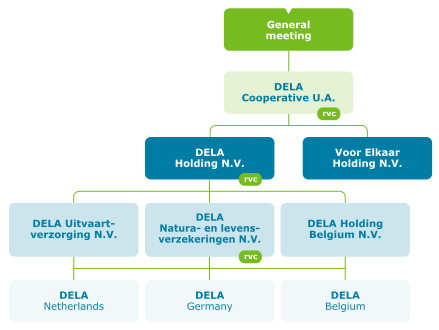
DELA Coöperatie UA includes DELA Holding NV and Voor Elkaar Holding NV. The Board members of the cooperative are also the Board members of these two entities.
In December 2022, DELA Holding NV and Yarden Holding BV legally merged, with DELA Holding NV becoming the remaining company. The holding includes three principal companies: DELA Natura- en levensverzekeringen NV (hereafter: DELA Natura), DELA Uitvaartverzorging NV and DELA Holding Belgium NV.
DELA Natura accommodates all Dutch, Belgian and German insurance activities, including those of Yarden. The German activities are carried out as a branch of Dutch insurance activities.
DELA Uitvaartverzorging NV is responsible for funeral activities in the Netherlands. The Belgian funeral activities are covered by the DELA Holding Belgium NV.
The principal companies include subsidiaries and participations. DELA Holding NV always governs the principal companies. Each principal company governs its subsidiaries. In addition, each company may have a director. The authority of each director is defined per company in its statutes, and the authorisation regulations for the relevant company segment and in the Chamber of Commerce registrations.
Voor Elkaar Holding NV was established to promote solidarity and cooperative business in the Netherlands via the establishment of or investment in parties with social missions that help people.
Permits and supervision
The registration number of DELA cooperative at the Chamber of Commerce is 17012026.
DELA Natura Group is supervised by The Netherlands Authority for Financial Markets (AFM) and Dutch central bank (DNB), and is registered under licence number 12000437. The Chamber of Commerce registration number of DELA Natura is 17078393.
DELA Belgium comprises insurance activities accommodated by the Dutch company DELA Natura Group, and funeral activities that are part of Belgian companies. Insurance activities are realised within the entity DELA Enterprises NV, the insurance activities are carried out under the licence issued by DNB and prudential supervision activities are also overseen by DNB. With regard to the supervision of conduct, DELA Belgium is accountable to the Belgian Financial Services and Markets Authority (FSMA).
Marketing and sales activities in Germany take place via a branch in Düsseldorf (article 2:115 Dutch Financial Supervision Act). All other activities take place at the head office of DELA Natura Group in Eindhoven (DELA Netherlands) The activities in Germany come under the independent business segment DELA Netherlands. Supervision is carried out by the Bundesanstalt für Finanzdienstleistungsaufsicht in Germany.
Members
Only natural persons can become a member of the cooperative. To become a member, they must enter into an (insurance) agreement as determined by the general meeting. The cooperative is divided into 40 geographical departments. The numbers, names and boundaries of the departments are described in the rules of procedure. Each member of the cooperative is part of a department.
Belgian policyholders have also been able to become members of the cooperative, since February 2022, initially as part of the Eindhoven department. A separate Belgian department will be established once a total of 100,000 members has been reached.
DELA cooperative honorary members
Mr F.H.J. Boons
Mr J.A.G. Dirks
Mr W.M. van den Goorbergh
Mr S.C.J.J. Kortmann
Mr J. Kremers
Mr A.J.M. Lauvenberg
Mr C.C.M. Libregts
Mr J.P. de Pender
On 7 February 2023 we were sad to learn that honorary member and former Supervisory Board member Mr A.W.M. van de Zande had passed away. He was an enthusiastic supporter of the cooperative for many years.
General meeting
The general meeting of DELA Group acts as the ‘highest level shareholder’ and is formed by individuals chosen from the members of the cooperative. To become a member of the general meeting it is preferred that the candidate has been a member of the DELA cooperative for over five years.
The general meeting consists of one member and one replacement member from each department.
A comprehensive and up-to-date overview of members per department can be found on the DELA website via https://www.dela.nl/over-dela/over-cooperatie-dela/governance/algemene-vergadering
Both the members and their replacements attend the general meetings, which in principle take place twice a year.
The meetings discuss issues important to the DELA cooperative, such as:
- The business plan for the coming year;
- The annual report of the concluded book year;
- Determining the financial statements and discharging the Executive and Supervisory Board;
- Approving changes to DELA insurance products related to all policyholders such as the annual premium increase of DELA UitvaartPlan;
- The appointment of (Supervisory) Board members.
The general meeting is also asked to consider developments important to the cooperative as well as issues such as the DELA charity funds, complaint procedures and funeral methods.
Confidential committee
In addition to the general member council, there is a confidential committee with four members selected from and by the general meeting.
The confidential committee is tasked with promoting cooperation between the general meeting and the Executive Board and Supervisory Board within the framework of the general meeting’s authorities. In view of this task, the confidential committee is invited by the Supervisory Board to meet with them prior to each general meeting. In addition, the committee has at least one meeting a year with the Executive Board.
Every member of the confidential committee is selected for a period of no more than four years. One member steps down each year in accordance with a schedule drawn up by the committee. A member who steps down can be immediately re-elected. The maximum term on the confidential committee is 12 years.
Supervisory Board
The Supervisory Board consists of at least five and at most seven natural persons as determined by this Board. If possible, there are two members who are also (replacement) members of the general meeting. The composition of the Supervisory Board is such that the combination of experience, expertise and independence of its members meets the Supervisory Board profile and allows it to perform its various duties. The members are appointed by the general meeting based on the suggestion of the Supervisory Board.
The tasks and duties of the Supervisory Board include overseeing, monitoring and providing advice to the Executive Board on:
- the realisation of the goals of the cooperative;
- the strategy and risks related to its activities;
- the setup and functioning of internal risk management and control systems;
- the financial reporting process;
- compliance with legislation, regulations and the risk policy;
In addition, the Supervisory Board ensures:
- compliance with and enforcement of the corporate governance structure;
- approving the financial statements, budget and material capital investments;
- selecting and appointing the external accountant and auditor;
- approving the risk tolerance;
- nominating members of the Executive Board for appointment and resignation;
- determining the remuneration policy.
The Supervisory Board evaluates the remuneration policy and the functioning of the Executive Board. The chair is the point of contact for any alleged irregularities regarding the functioning of Executive Board members.
In fulfilling its duties, Supervisory Board members focus on the interests of the cooperative and its associated companies. They carefully consider the interests of the various stakeholders of the cooperative in doing so, including members and employees. The Supervisory Board itself is responsible for the quality of its own functioning.
Regulations
The Supervisory Board has internal regulations that provide rules for its decision-making process. The regulations are drawn up by the Supervisory Board and confirmed by the general meeting. They serve as a supplement to the regulations and guidelines that apply to the Supervisory Board based on Dutch legislation and the cooperative’s statutes.
Appointment and term
Each Supervisory Board member is appointed for a period of up to four years, in the understanding that a member will step down at the latest after the first general meeting held after four years have passed since their latest appointment. A member who is stepping down can be reappointed immediately, insofar as the maximum term of 12 years is not exceeded.
Committees
The Supervisory Board has an audit committee, risk committee and a remuneration and appointment committee.
Participations
The members of the Supervisory Board of the DELA cooperative are also appointed as Supervisory Board member for DELA Holding NV and DELA Natura. The establishment of a Supervisory Board was compulsory for DELA Natura Group based on the Dutch Financial Supervision Act.
Personal details of the Supervisory Board
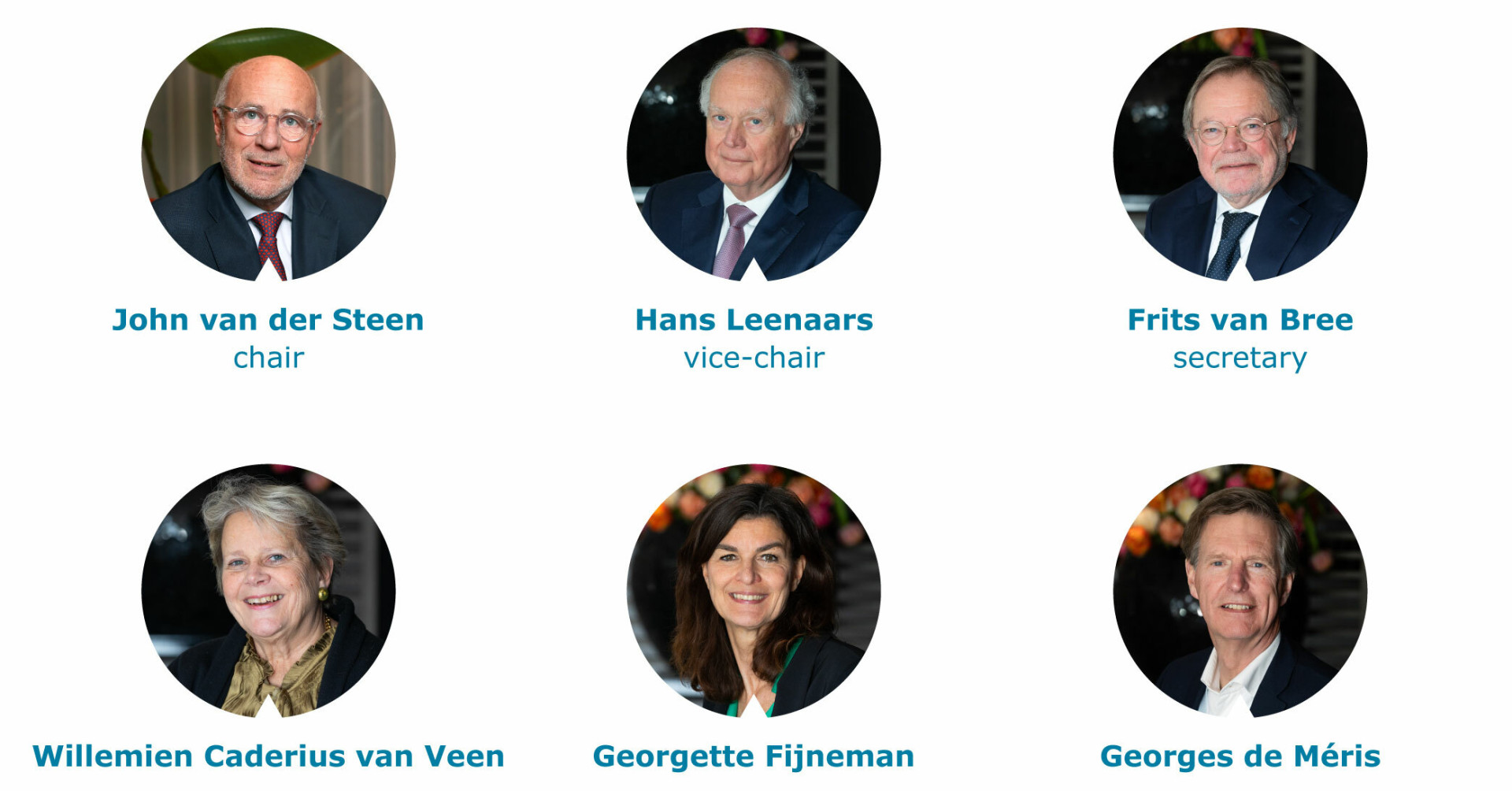
The Supervisory Board has six members. All are part of the Supervisory Board of DELA Coöperatie UA, DELA Holding NV and DELA Natura- en levensverzekeringen NV.
Mr J.W.Th. (John) van der Steen (1954), chair
Male, Dutch citizen. Appointed in 2019, currently serving first term. Function: professional supervisor, DGA Ansteen Holding BV. Other additional functions: chair of Supervisory Board of BinckBank NV, chair of Supervisory Board of Princess Sportsgear & Traveller BV, member of the Executive Board of Stadhold (Randstad) Insurances SA and Stadhold Reinsurances SA, member of Executive Board of Vereniging AEGON, Ambassador for Royal Concertgebouw Orchestra.
Mr J.J.A. (Hans) Leenaars (1952), vice-chair
Male, Dutch citizen. Appointed in 2015. Currently in second term. Position: professional supervisor. Additional functions: member of Executive Board of Stichting John van Geunsfonds, chair of Supervisory Board of Stichting Het Klooster Breda, chair of Executive Board of Stichting Via Nobel, Chair of Advisory Board of ILFA BV.
Mr G.C.A.M. (Frits) van Bree (1952), secretary
Male, Dutch citizen. Appointed in 2021 by members of the general meeting, currently in first term. Position: professional supervisor. Additional functions: council member of Vereniging Eigen Huis.
Ms W.A.P.J. (Willemien) Caderius van Veen (1959)
Female, Dutch citizen. Appointed in 2014 and now in third term. Position: professional supervisor, DGA Caadje BV. Additional functions: member of Supervisory Board of Unilever Nederland Holdings BV, chair of the Review Committee Pensioenfonds Lloyds Register Nederland, member of Supervisory Board of Woningcorporatie Trivire, member of Supervisory Board of Ondernemingspensioenfonds Capgemini.
Ms G.M. (Georgette) Fijneman (1966)
Female, Dutch citizen. Appointed in 2022, currently in first term. Position: chair of Executive Board of health insurance company Zilveren Kruis. Additional functions: vice-chair of Zorgverzekeraars Nederland, Executive Board member of Kansfonds.
Mr G.H.C. (Georges) de Méris (1961)
Male, Dutch citizen. Appointed in 2019 by members of the general meeting, currently serving first term. Position: external consultant Corporate Finance, Forensics & Recovery Joanknecht. Additional functions: member of Supervisory Board of Omroep Brabant, member of Supervisory Board of Hy2Care BV, member of Supervisory Board of Caelus BV, chair of Supervisory Board of Matisse BV, member of Supervisory Board of Theaterfestival Boulevard (until 2022), board member at Stichting SFO.
Executive Board
The cooperative has an Executive Board, which consists of a number of natural persons to be determined by the Supervisory Board. With the exception of limitations indicated in the statutes, the Executive Board manages the cooperative and its capital. The Executive Board can determine which special tasks will be/are assigned to which of its members. The task distribution must be approved by the Supervisory Board.
Personal details of the Executive Board
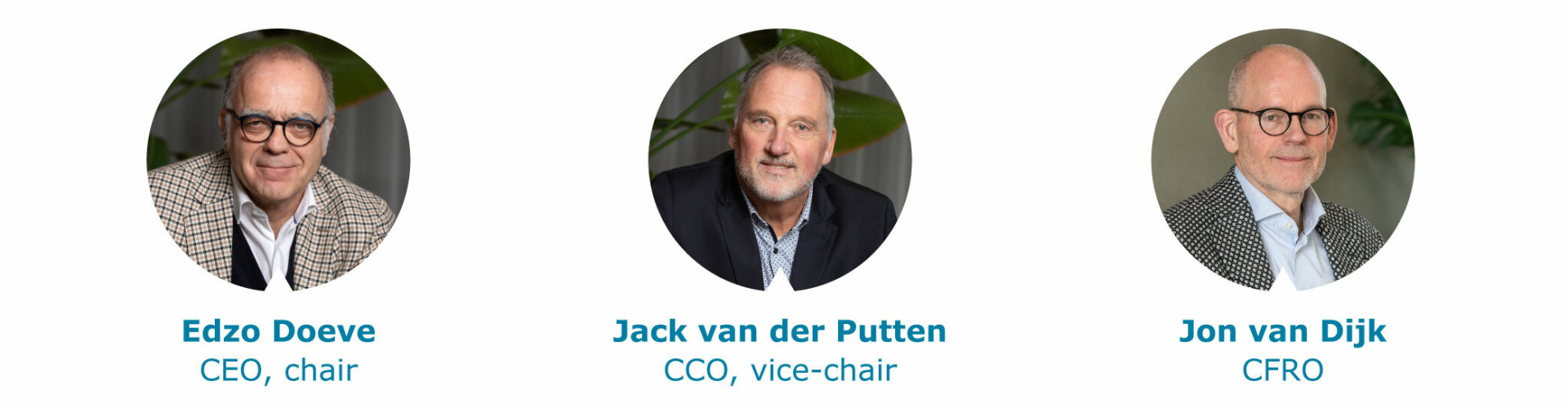
Mr E. (Edzo) Doeve (1956), CEO, chair
Male, Dutch citizen. Position in the DELA Group: CEO, chair of Executive Board (since 2004). Focal areas: strategy, internationalisation and general policy. Active as Managing Director of DELA Netherlands (since 2004). Employment period: indefinite. Additional functions: chair of Executive Board of national funeral museum Tot Zover, chair of Supervisory Board Eindhoven 365, chair of Stichting Promotors Van Abbemuseum, chair of Vereniging Impact 040, Board Member of DELA charity fund, member of Advisory Board of Brabantse Dag, member of Advisory Board ORMIT.
Mr J.A.M. (Jack) van der Putten (1959), CCO, vice-chair
Male, Dutch citizen. Position in the DELA Group: CCO, member of Executive Board (since 2010) and deputy chair (since 2010). Focal areas: strategy and Voor Elkaar Holding. Also active as Director of DELA Netherlands (since 2010). Employment period: indefinite. Additional functions: chair of Stichting Onbeperkt Genieten, member of Supervisory Board UNC Holding BV (until 1-1-2023).
Mr J.L.R. (Jon) van Dijk (1957), CFRO
Male, Dutch citizen. Position in the DELA Group: CFRO, member of Executive Board (since 2014). Focal areas: strategy, finance and risk management. Employment period:indefinite. Additional functions: treasurer of Stichting Los Niños, board member Stichting Derdengelden Muntenburg Advocatuur (from April 2022), member of Supervisory Board and chair of audit committee Finances and Real Estate at Stichting Oktober (until June 2022).
Independent business segments and directors
The group includes independent business segments (ZBOs), of which there were two at the time of writing this report: DELA Netherlands and DELA Belgium. Each business segment has its own management team that reports to the Executive Board, one member of which is primarily responsible for a segment. The management team has regulations that include the responsibilities and authorisations of the team.
DELA Netherlands directors
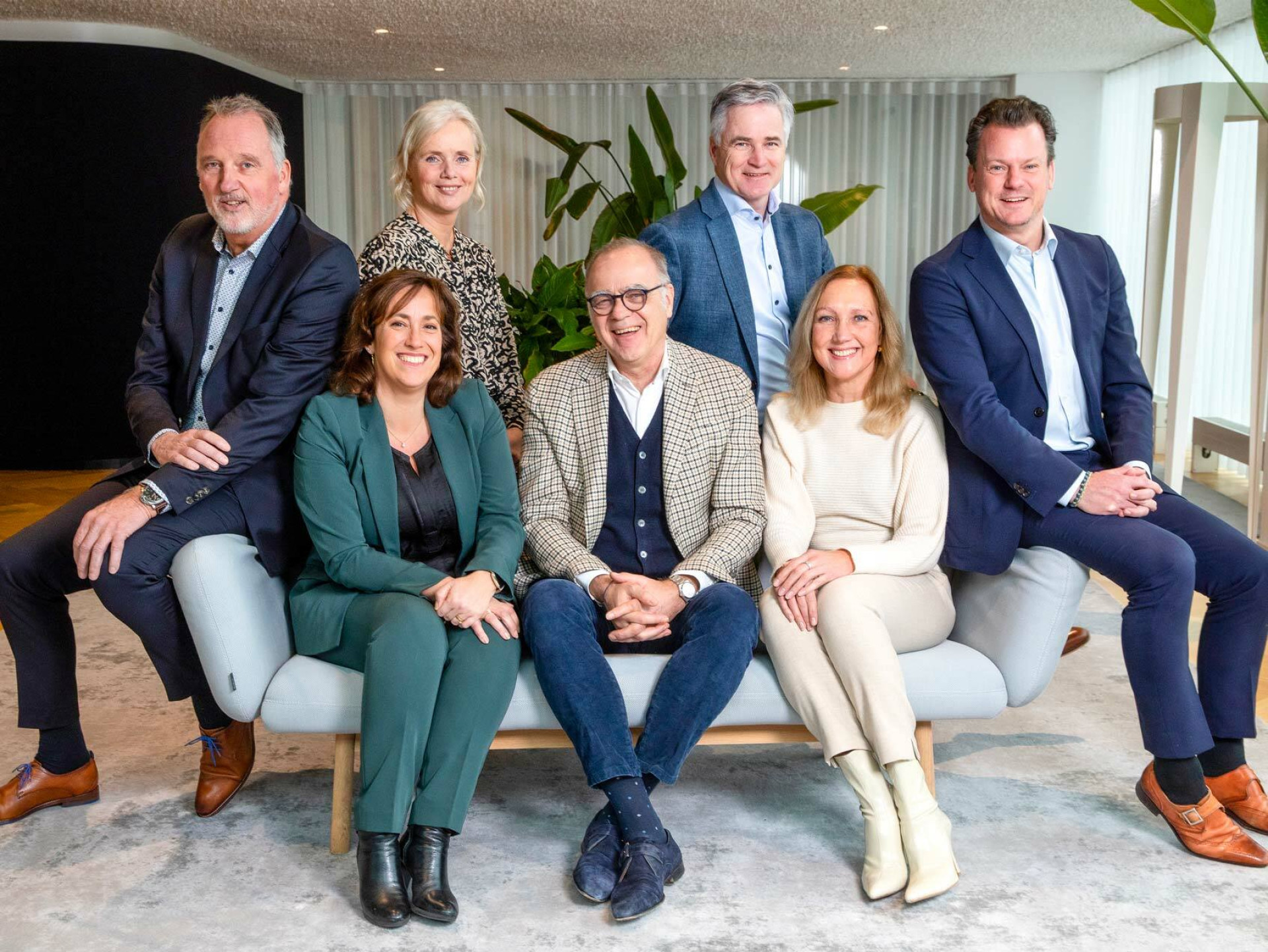
From left to right: Jack van der Putten (vice-chair/funeral services), Véronique Klaassen (funeral care), Roos Fleuren (HR), Edzo Doeve (CEO), Alfo Melisse (IT), Godelieve van Velsen (CFO) and Chris Beaulen (insurance)
An independent business segment management team is tasked with implementing the strategy, managing and providing management information for the consolidation of the group, dealing with formal/legal issues, and sound decision-making as defined in the statutes of the segment and the regulations. This management model ensures professional and well-balanced operations with proper checks and balances.
DELA Belgium directors
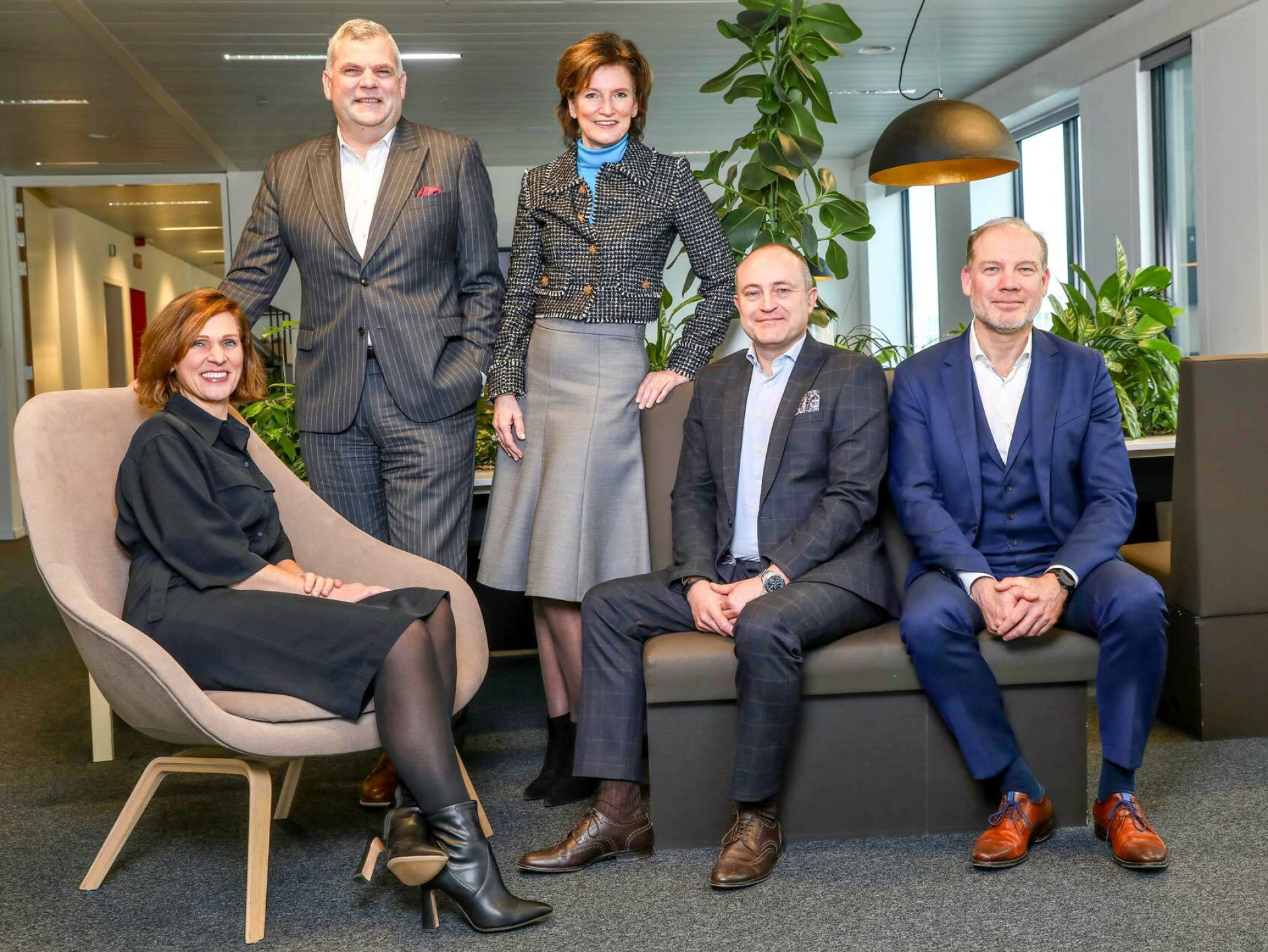
From left to right: Hanna Zijlstra (HR), Bruno Moors (CFO), Sandra Schellekens (CEO), Wim Delplace (funerals) and Geert Deschoolmeester (insurance)
Policy
Policy that applies to the entire group falls under the responsibilities of the Executive Board and is considered group policy. Policy that relates to an independent business segment comes under the responsibilities of the management team of that segment. The management teams of the independent business segments determine their own policy within these frameworks. Group policy issues include branding, IT, data management, security, privacy, investments, capital management, ORSA, ALM, fiscal/tax, reporting & control, communications, CSR, remuneration, risk management and internal control.
Investments
DELA Group’s investment activities are run from the Netherlands. DELA has an investment advisory committee (BAC) which has an advisory and evaluating role to the Executive Board on investments. In addition, it is asked for advice regarding policy proposals, policy changes and the implementation of policy in this field. If the committee’s advice is ignored by the Executive Board, the Executive Board must report this to the Supervisory Board. The investment advisory committee has an explicit advisory role and evaluates whether proposals are consistent, comprehensive and sound with regard to return and risk. The Executive and Supervisory Board maintain their own responsibilities. The investment advisory committee is composed of at least three external members who are appointed by the Supervisory Board as proposed by the Executive Board.
Integrity
DELA finds it important to have a consistently professional and well-balanced business with appropriate checks and balances within the right culture. The culture of DELA is characterised by the values of engagement, integrity and entrepreneurship.
An important part of DELA’s integrity policy is to ensure that every DELA employee acts with integrity. This means that employees are honest, open, clear and meticulous. To further define the term integrity for employees, we have published a code of conduct that indicates the rules employees should follow to enhance their integrity on various focal areas. The code focuses on issues such as conflicts of interest and corruption, improper behaviour, reporting malpractices, unauthorised competition and private investment transactions.
The code of conduct and underlying regulations are based on internal and external legislation and regulations, and were drawn up for DELA Netherlands. DELA Belgium has an integrity code with underlying regulations which are focused specifically on the Belgian situation and market, including legislation. DELA Germany has composed a handbook related to integrity which is based on the Dutch code of conduct and in accordance with German legislation.
DELA’s Executive Board is responsible for realising adequate safeguards related to integrity in DELA’s business practices. All employees are responsible for implementing integrity in DELA’s operations.
Risk management

Risk management
Risk management makes a direct contribution to long-term goals and provides an insight into the sensitivities and correlations of strategic, financial, operational and compliance risks to ensure that DELA can effectively address developments and take timely action to realise its goals and secure continuity of the organisation.
Model
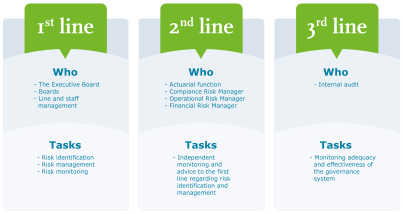
DELA applies the ‘three lines of defence’ model for the setup of the management and control of risks:
- The first line is primarily responsible for realising the formulated goals of the company and the demonstrable realisation of internal control measures and effective risk management. Responsibilities of the first line include the operations, results, definition of risk appetite, management and compliance with internal control measures;
- The second line provides advice, coordinates, safeguards and evaluates – independently from the first line – whether or not the first line is actually taking responsibility and operating within the risk tolerance of DELA;
- The third line ensures additional security of the quality of internal control via audits.
The independence of the second and third lines is an important starting point to ensure this model functions properly, which is why it is safeguarded. The overview below shows a schematic representation of the model.
Process
DELA has a process for risk management that ensures an insight into the main risks and opportunities in all circumstances and that opportunities, risks and applicable control measures are always carefully weighed. The risk management process is continuous as summarised below.
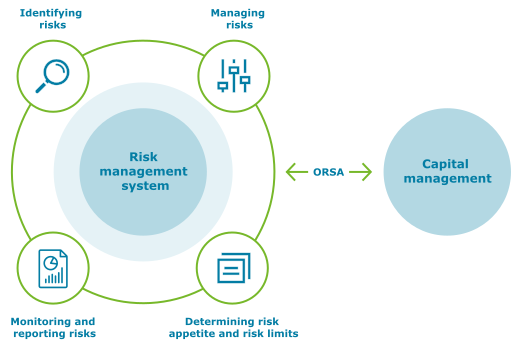
Identifying risks
Risk identification is primarily the responsibility of the first line. The second line periodically analyses the risks identified by the first line and supplements them where necessary, with a special focus on upcoming risks. This analysis is then discussed in meetings between the first, second and third line.
Determining risk appetite and risk limits
The Executive Board evaluates the risk profile every year based on predetermined operational goals and the capacity of the organisation. In addition, the Board determines the risks DELA is prepared to take – based on its risk profile – to achieve its strategic goals, in line with its risk appetite. In addition to the intended goals, it is essential that the continuity of the organisation is secured. The risk appetite consists of the risk appetite statements and the declarations on quality and quantity. These are translated into risk limits and risk tolerances to enable continuous monitoring and control.
The most important qualitative statements from the risk appetite are:
- DELA accepts no disproportionate premium increases.
- DELA accepts significant market risks as the taking of such risks is an explicit part of its business model.
- DELA does not accept significant cost overruns as a result of its regular operations.
- DELA accepts no form of internal or external fraud.
- DELA accepts no risks that could fundamentally threaten DELA’s reputation.
- DELA does not accept increased risks related to information security or cyber security.
A detailed explanation of these risks is included in the financial statements.
Managing risks
To ensure the risks remain within the desired bandwidths, DELA applies suitable risk mitigation solutions. In most situations this involves a suitable mix of:
- terminating or outsourcing activities;
- reducing risks by applying preventative measures;
- transferring risks via (re)insurance and/or the application of contract management;
- accepting risks that can be carried by the organisation itself.
If risks are outside of the predetermined risk limits – and therefore larger than desired – management will take additional risk mitigation measures. The deliberate breach of risk limits is only allowed with approval from the Board, and only when of a temporary nature. The risk appetite statements were evaluated and optimised in late 2022, including changes to the thresholds.
Monitoring and reporting
Monitoring and evaluating risks and the risk management system are important preconditions for the type of learning organisation that DELA aims to be.
In assessing a risk an evaluation is made of whether it remains outside the risk appetite level. The starting point is that risks exceeding the appetite are reduced to a lower risk level based on a good mix of risk mitigation solutions.
To ensure constant risk monitoring, management determines KRIs (key risk indicators) for each risk within the risk profile, monitors the development of these indicators at least once per quarter, and evaluates the extent to which risk limits and tolerances are exceeded. Extra management actions are defined when breaches occur. In addition, the second and third line periodically report to the Board.
Management periodically participates in a Risk Control Self Assessment (RCSA) process which results in a Control Statement (ICS). In addition, the Internal Audit department evaluates the setup and effectiveness of the risk management system.
Own Risk and Solvency Assesment
Solvency II requires a demonstrably balanced weighing up of risk management, capital management and the corporate strategy. The ORSA is the process structure for this assessment and the degree of compliance is shown in the ORSA report. The content of the scenarios and stress scenarios is determined by the Board before the ORSA starts, after obtaining advice from the second line.
Management uses the Own Risk and Solvency Assessment (ORSA) at least once a year or when developments occur that may significantly affect the risk profile. This helps determine whether the risk profile is still fitting in light of the company goals, risk appetite and available capital buffers. Various scenarios and stress scenarios are taken into account in this process.
The results of the ORSA 2022 show that DELA’s solvency position is robust. Coverage significantly increased in 2022 due to the interest rate rises during the year. This is in line with the qualitative statement: “DELA does not accept disproportionate premium increases.”
DELA has no influence on interest rates or inflation curves, but can have some impact on the amount of funeral costs. The ORSA 2022 showed that scenarios with low funeral cost inflation (combined with low interest rates) could put pressure on the solvency and/or premium increase.
Capital management
Capital policy is aimed at maintaining a solid solvency position, in which DELA is constantly looking for a good balance between the amount of capital (assets) it maintains and the risks it faces. In this framework, DELA has defined a minimum normative value of solvency which DELA always aims to exceed. The capital policy defines various actions should the solvency ratio drop below the benchmark. The benchmark for each licensed entity (DELA Cooperative and DELA Natura) has been established at 150 percent.
The solvency ratio was constantly higher than the solvency benchmark during 2022.
For more details on risks and how they are managed please refer to the financial statements: ‘Consolidated financial statements’, ‘Notes on the consolidated balance sheet and income statement’, ‘4. Risk’.